Brand mentions are references to a brand. A mention does not automatically establish a link, source citation or recommendation. Check identity and context first. For AI answers, also record the question, environment, time and sources that are actually available.
What are brand mentions?
A brand mention is a reference to your brand in text or another piece of content. It may appear on a website, in a post or in an AI answer. The name alone does not establish that your business is meant, or whether the context is positive, critical or incidental.
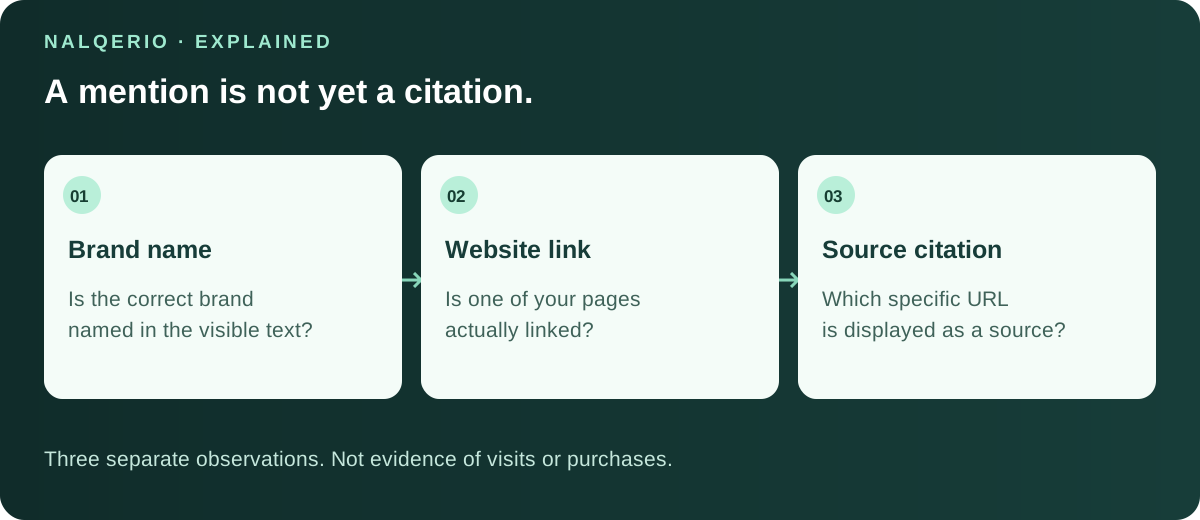
Use three separate fields in your analysis: is the brand named? Is there a link to your website? Is a specific URL displayed as an answer source? An answer can name your brand while citing only a third-party review. Your website can also be cited without the visible answer using your brand name.
This guide focuses on individual observations. The share-of-voice guide covers proportions relative to competitors. The LLM seeding guide explains how to assess and develop reliable external information.
Three cases to keep separate
These examples were written for explanation. They are not actual provider answers or customer results. Open the cards and consider what each observation really establishes.
Name only: “Example Brand offers scheduling software.”
A mention is present. The factual accuracy still needs checking. Without a link, the example does not show a backlink or a visibly assigned source URL.
Name plus third-party source: a review is linked
The brand appears, but the source belongs to another publisher. Record that third-party URL. Do not count it as a citation of your own website.
Your URL is cited, but the name is absent
A specific page on your domain is displayed as a source. This is a source observation. It does not yet establish a visible brand mention or recommendation.
A recommendation also needs context: what task is the offer being suggested for, and under which conditions? “Provider X also exists” says something different from “Provider X suits this case because …”. Keep that distinction when reporting the result.
Find brand mentions with a small manual search
Start with the exact brand name, known spellings and your domain. A search pass provides leads, not a complete inventory of the web. Results vary and some content will be absent.
| Aim | Possible search | What to check next |
|---|---|---|
| Find the exact name | "Your Brand" | Is this really your business? |
| Exclude your own website | "Your Brand" -site:your-domain.com | Which independent pages mention the name? |
| Find a comparison context | "Your Brand" comparison | Is there an independent examination or copied product copy? |
Replace the placeholders and open the original content. A search snippet may be shortened or outdated. Record the exact location, publisher and review date. Inspect links on the page itself; a name search does not reliably tell you whether a backlink exists.
If the name is ambiguous, compare the domain, offer, location and company identity. The entity SEO guide explains how to make these associations clearer on your own website.
Keep a log that explains more than a hit count
Save one row per observation. For an AI answer, include the actual question. For a website mention, include the page URL. Keep what you observed separate from your interpretation so someone else can trace the conclusion.
- Location: URL or stored answer evidence, date and environment.
- Identity: correct brand, possible confusion or unresolved.
- Context: the specific claim and its conditions.
- Links: your destination URL, third-party source URL or no visible link.
- Interpretation: mentioned, recommended, criticised or unclear.
- Next task: no change, check a product statement or prepare a factual correction.
Use “unknown” when the evidence is insufficient. Content you cannot retrieve is not a confirmed negative mention. Several URLs reproducing the same copy do not automatically represent several independent assessments.
For a small AI sample, use the AI visibility measurement log. At a later review, keep the previous observation and create a new entry. That makes changes inspectable without rewriting the earlier evidence.
To publish a verifiable original resource, start with the digital PR topic review.
Brand sentiment: assess tone separately from factual accuracy
Brand sentiment describes the way a brand is presented: favourably, neutrally, critically or with mixed signals. A positive adjective is not enough to understand how AI portrays your business. An enthusiastic answer may invent a capability; a critical answer may accurately describe a limitation. Read the specific claim and assess tone separately from factual accuracy.
| Check | Possible finding | Record |
|---|---|---|
| Identity | Correct brand / mistaken identity / unclear | Domain, offering and name used |
| Tone | Positive / neutral / critical / mixed / unclear | The exact wording in its context |
| Facts | Confirmed / contradicted / unchecked | The claim and its current authoritative product page |
| Source support | Supported / partly supported / unresolved | Which available source supports this particular claim |
| Follow-up | Correct / explain / observe | The responsible page and a reason for the next step |
Fictional example, not an observed AI answer: “LindenPlan is wonderfully convenient and automatically synchronises with every calendar.” The tone is positive. The universal calendar claim is initially unchecked. If the current product documentation lists only one supported calendar, record the contradiction. Enthusiasm does not make an inaccurate capability statement true.
Consider a second example: “LindenPlan is currently unsuitable for teams that cannot use the supported calendar.” This is restrictive language, but it may help someone make a sound decision. Check whether the prerequisite is correct. Do not treat an accurate limitation as an error simply because its tone is critical.
Before reviewing a larger sample, write down a short set of classification rules. Ask another person to review ambiguous cases, and retain “unclear” when the evidence does not support a decision. If you calculate proportions, state how you selected the answers, the period and the number that could be assessed. These proportions cannot describe the overall mood of your customers.
This matrix is a manual worksheet. Nalqerio documents selected authorised API answers and available sources; it does not promise an automatic sentiment-analysis feature here. Use the AI hallucination guide to investigate incorrect facts and the grounding review to check whether a source supports the claim.
Assess ChatGPT brand mentions and other AI answers
Start with a customer decision: “Which software suits a small agency that needs to inspect source evidence?” This differs from “What does our brand offer?”. The second question already contains the name. Do not combine the two into a single apparent awareness figure.
Record the environment. A personal ChatGPT conversation, an API response and Google AI Overviews are different observations. Results depend on factors such as the question, available sources and time. A saved API answer documents that sample, not what every individual user sees.
Read the original answer, confirm the brand identity and open the available sources. Does a source support the relevant claim? Is the URL still accessible? A source list does not establish that every statement in the answer appears on your website.
The ChatGPT SEO guide explains the environment distinction. Use the Perplexity source matrix to connect a statement to a specific supporting URL.
A favourable mention can still contain incorrect facts. The AI hallucination guide explains a separate claim review.
Unlinked mentions: what does a mention without a link mean?
An unlinked mention names the brand without linking to its website. It may still help readers, for example in a factual explanation. It does not provide a direct clickable path to your page and is not a backlink. Do not assign it a promised SEO effect.
First ask whether a link would improve that particular piece of content. An official methodology page might help in a tutorial, while a passing name reference may not need a link. If you later request a correction, focus on reader benefit and respect the publisher's editorial decision.
Do not buy supposedly independent mentions or automatically distribute identical promotional copy across other websites. Google's spam policies cover manipulative link practices. Producing an inspectable contribution is a different task from maximising a name count.
On your own website, connect unclear statements to their evidence. The E-E-A-T guide shows a practical way to do that.
What does Nalqerio provide, and what does it not measure?
With Nalqerio's AI brand monitoring, you examine selected authorised API answers to customer questions. You can inspect observed brand mentions and available sources in their answer context. Provider coverage and availability depend on your current access; the methodology remains the reference for scope.
Nalqerio is not a complete web or social-listening service. It does not read personal ChatGPT conversations or directly measure Google AI Overviews or Microsoft Copilot. Absence from the selected sample does not establish that your brand is absent everywhere.
For a separate data source, website owners can inspect available citation data in Bing's AI Performance report. Microsoft describes citations across supported AI experiences. Keep that reporting separate; do not add it to an API sample without compatible definitions.
Visits and purchases are a further type of observation. The AI traffic measurement guide explains why website visits and name mentions need different evidence.
Whether people later search for your name is a separate question: the branded search guide explains how to analyse brand-related queries independently.
Turn one mention into a useful next task
Take a single observation. If the brand is confused with another, check your identifying company information. If a product limit is misstated, examine the reference page you control. If a third-party source is outdated, record the specific error and current evidence. A neutral, accurate mention may need no change.
After a real edit, review the answer again under comparable conditions. Retain both the old and new evidence. A different answer does not by itself prove your edit caused it; other sources and model changes may also contribute.
A useful first pass needs only one important customer question and a carefully read answer. In the free Nalqerio trial, you can inspect your project's available answer evidence. Start with a traceable baseline and derive one concrete website task from it.
Frequently asked questions
Is a brand mention always a backlink?
No. A name can appear without a link. A backlink leads from another website to your page. An AI source citation is additionally tied to the context of a particular answer.
Can I find every brand mention in ChatGPT?
No complete inventory is available through this process. Personal conversations are not a public research database. A defined API sample answers selected questions under recorded conditions and has corresponding limits.
Are more brand mentions automatically better for SEO?
A count alone does not describe relevance, accuracy or usefulness. Inspect the original content, correct identity and context. It does not establish a promised ranking effect.
Does a source citation mean someone visited my website?
No. A displayed source URL is not evidence of a click. Visits, registrations and purchases need their own lawful data basis and cannot be inferred from a mention.
Does brand sentiment measure customer satisfaction?
The tone of selected texts or AI answers is not a customer survey. Record the source, sample and assessment rules, and examine genuine customer feedback as a separate evidence source.
Sources and further reading
- Google Search Central: AI features and sources
- Microsoft Bing: AI Performance and citations
- Google Search Central: spam and link policies
- Nalqerio: measurement environment and limitations
Methods, product scope and sources reflect the publication date shown. Examples are not measurements of your website. Linked product pages provide current plan and provider details.
