Define the questions, market and measurement system first. Preserve the original answers, distinguish mentions from citations and keep missing data separate from negative results. Then decide which page on your website needs a closer look.
Define what AI visibility means for your project
In this guide, AI visibility means that your brand or website appears in a specified AI system's answers to selected customer questions. This is a bounded sample, not your share of the entire AI market. A question naming your brand measures something different from an open-ended request for suitable suppliers.
Separate three observations. A brand mention means the name appears in the answer. A citation links a particular page as a source. A recommendation concerns context: the brand may be recommended, criticised or mentioned in passing. None of these observations is automatically a sale.
Record the measurement environment too. A manual ChatGPT search, an API request and a Google search result are not interchangeable. Nalqerio records API responses and their supporting evidence; it does not reproduce every user's chat experience. Read the measurement methodology before interpreting the numbers.
Choose questions that precede a buying decision
Start with a decision rather than a long keyword list. Who needs a solution, for which task, and under what constraints? Use real sales conversations, support requests or your own search data where available. Ideas without that evidence remain hypotheses.
For a running example, consider a small SEO agency evaluating monitoring software. These are suggested questions, not measured searches or demonstrated results:
- Which tools help a small SEO agency monitor brand mentions in AI answers?
- How can an agency check which websites are cited in AI responses?
- Which features does a GEO tool need to support several client projects?
A separate branded question such as “What does Nalqerio offer?” can help check the accuracy of product descriptions. Do not combine it with open supplier questions when describing discovery. Mentioning your brand in the prompt changes the question you are testing.
Keep the first set small and commercially relevant. Ten slight variations of the same wording do not necessarily represent ten independent needs. Give each question a business purpose and an owner who can act on its findings.
For a particular ChatGPT answer, use the ChatGPT observation log. When a linked source contains an unclear or outdated claim, the Perplexity source matrix helps map it to evidence.
Keep the measurement conditions consistent
Record the exact question, date, language, target market, provider and available model or methodology version. Note whether web search was used. For a manual check, also record the visible conversation context: a long discussion about your brand is not a neutral starting point.
For API-based software, ask how search is connected. Nalqerio evaluates OpenAI, Gemini and Perplexity separately. Gemini uses separate web search supplied through Perplexity, so its search foundation is not the same as the Gemini app. Check current availability and the displayed scope before starting a measurement.
For Gemini measurements, distinguish the app, API and Google Search. Do not transfer a conclusion from one environment to another without evidence.
Prompt monitoring: maintain a stable question set
Here, prompt monitoring means repeatedly observing selected customer questions under documented conditions. Give each question a stable identifier, exact wording, language, provider and purpose. Preserve the complete question instead of a broad topic label such as “agency software”.
A substantial wording change creates a new version. Do not silently compare it with the previous series. Check the question set for relevance too: a service no longer offered should not remain in the regular review. Record failed observations separately from absent brand mentions.
Choose a rhythm that fits actionable work and your plan. More requests do not automatically produce more insight. The Nalqerio trial includes one complete snapshot in total and no automatic repeats; recurring measurements depend on the paid plan. The reporting template connects observations to follow-up tasks. Use the search intent review to check that the question still describes a relevant customer decision.
Save the answer and inspect the evidence
Read the complete response before accepting a metric. Does the answer refer to your company or a different business with the same name? Is the linked evidence your domain, an independent review or a passing reference on someone else's website? Open the source and check whether it supports the statement.
The following is a blank working template, not a client measurement. It can be used without Nalqerio. Do not collect confidential client information that is unnecessary for the question.
| Field | What to record |
|---|---|
| Question and context | Exact prompt, language, market and audience |
| Measurement | Date, system, known model, web search on/off |
| Original evidence | Saved answer or permitted screenshot |
| Brand mention | Yes, no, or unknown because the answer is missing |
| Own-site citation | Specific cited URL; record citation availability separately |
| Interpretation | Accurate statement, mistaken identity or open question |
| Next step | Target page, verifiable change and responsible person |
Download the plain-text measurement worksheet → Free, with no registration.
Open the editable print view ↗
Use one sheet per question and system.
Read each metric with its denominator
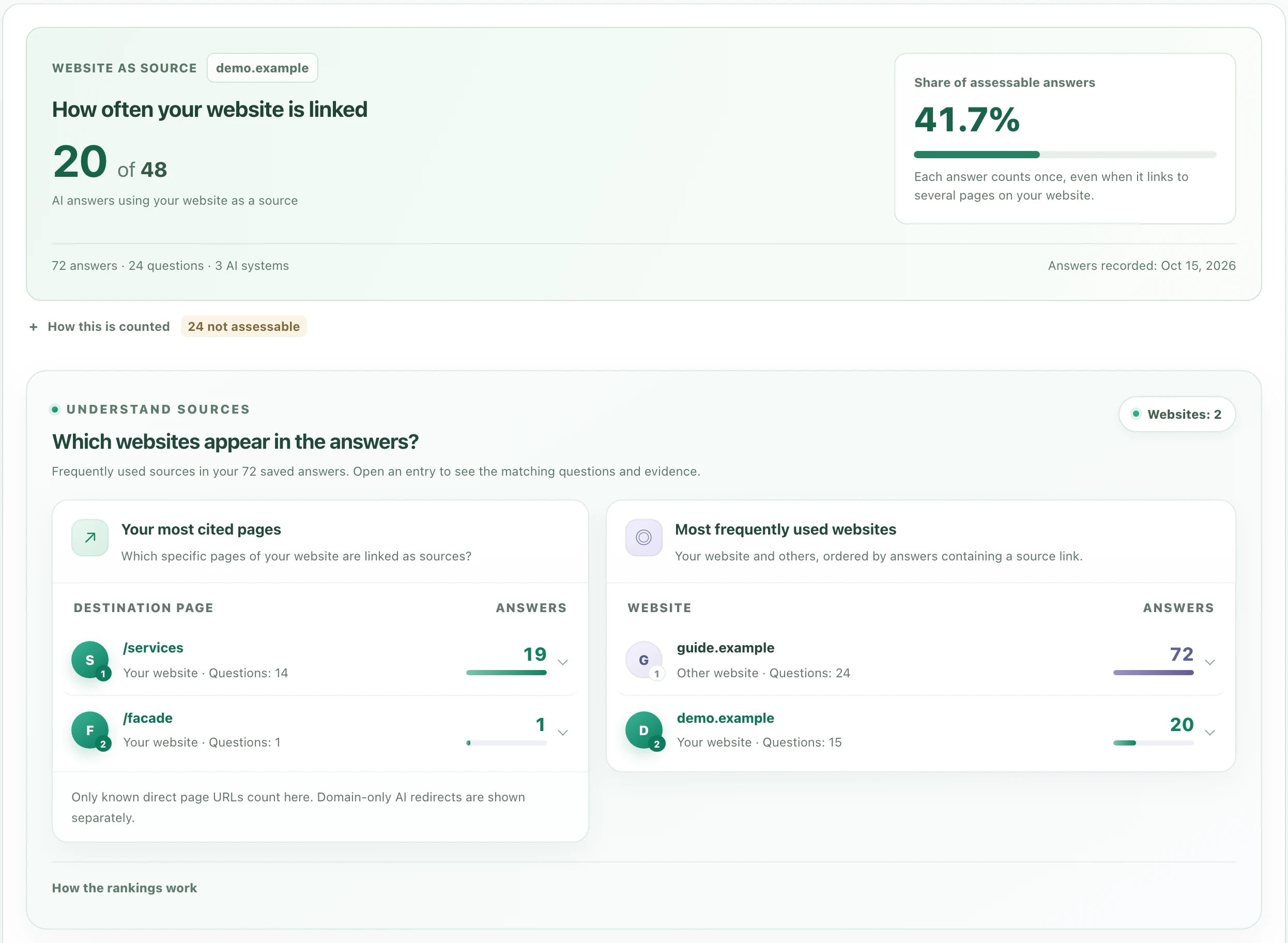
Answer mention rate is the number of evaluable answers mentioning the brand divided by all evaluable answers. Question coverage asks a different question: how many evaluable questions received at least one mention? A tool should make the distinction understandable.
Arithmetic example, not a measurement: Three systems successfully answer one question. Only one response mentions the brand. Answer mention rate is 1 out of 3, approximately 33%. Question coverage is 1 out of 1, or 100%. These describe the same small sample in different ways.
A failed response must not silently become “brand absent”. Record the failure separately. An available but empty source list also differs from unavailable citation data. Always show the basis of a metric and how many answers were actually evaluated. The Nalqerio metric definitions explain these distinctions.
Percentages can look precise when the sample is tiny. Report counts first. Do not treat a few answers as proof of what every prospective customer sees.
For a relative comparison against confirmed competitors, see how to calculate share of voice. The worked example separates competitive share from the answer mention rate.
The GEO reporting template shows how to explain these metrics with denominators and limitations.
Turn an observation into a specific task
Suppose a commercially important question concerns integrations. First inspect your product page: does it describe the integrations you actually offer, clearly and accurately? When useful information is genuinely missing, add it with supporting evidence. Never turn a model-invented feature into a claim on your website.
Record the published change and run a later measurement under comparable conditions. A different response is initially an observation. Model changes, new sources or variation may contribute; one before-and-after check does not establish causation.
For an absent brand, follow the missing-mention diagnostic guide. When selecting ongoing software, use the GEO tool evaluation checklist. Track search visits and paying customers separately: a citation is not a website visit, and a visit is not a sale.
A mention becomes commercially useful through what happens next. The AI traffic guide explains a separate review of identified visits and registrations. The query fan-out content map helps select useful follow-up questions.
Try the process with Nalqerio
The free trial includes one project, three customer questions and one complete AI snapshot across the available providers. The 14 days start with your first project. No credit card is required, and the trial does not automatically become a subscription.
The trial does not include automated monitoring, targeted rechecks or exports. For ongoing measurement, compare Starter and Pro. Both paid plans include four complete measurement rounds per billing period, shared across the entire account. The scope is shown before starting. Read the current plan details rather than assuming that question slots imply unlimited runs.
For a first session, choose one real customer decision. Review the original answers with a colleague. Then decide whether ongoing monitoring would support a recurring task in your business.
For implementation after measurement, use the GEO optimisation workflow. Review technical and content obstacles separately in the GEO audit.
If an answer leaves you unsure whether the brand is named or only a URL is cited, use the brand mentions and source examples. For the next website task, assign customer questions to clearly responsible pages.
Frequently asked questions
Can I measure AI visibility for free?
You can document a manual sample using your own worksheet. Nalqerio also offers a 14-day trial with one project, three questions and one complete snapshot. It is not unlimited free monitoring.
Is an API result identical to a ChatGPT answer?
No. The system, search connection, model and conversation context may differ. A documented API sample should not be presented as a universal ChatGPT ranking.
How often should I measure again?
Choose a cadence that supports your decisions and fits your allowance. Consistent questions and documented conditions matter more than repeated ad hoc prompts. New questions need a new comparison baseline.
Sources and further reading
- Nalqerio: measurement methodology and metrics
- OpenAI: searching the web with ChatGPT and checking sources
- Nalqerio: trial scope and plans
Methods, product scope and sources reflect the publication date shown. Examples are not measurements of your website. Linked product pages provide current plan and provider details.
