Share of voice is a brand’s proportion of a defined total. For AI answers, one approach counts brand mentions: your mentions divided by mentions of all included brands. That differs from the proportion of answers mentioning your brand. Fix your questions, competitors and measurement conditions before comparing the percentages.
What does share of voice mean?
Share of voice (SoV) is your brand’s proportion of a defined pool of visibility. Depending on the measurement, that pool might contain advertising impressions, recorded mentions or estimated organic visibility. A statement such as “30% share of voice” is incomplete unless it identifies the pool.
For AI share of voice, this guide looks at brand mentions in a bounded sample of AI answers. We count your brand and a predefined set of competitors. The result describes your relative presence within that set. It is not your share of every AI question asked around the world.
| Environment | Possible basis | What to check |
|---|---|---|
| Media and social listening | Recorded brand mentions | Which media and search filters are included? |
| SEO | Estimated visibility for a fixed keyword set | How are positions and search demand weighted? |
| AI answers | Recorded mentions of selected brands | Which questions, systems and competitors belong to the set? |
AdVision’s definition describes the classic calculation using brand mentions. The next section sets out the counting rules for our AI sample. Our existing guide to measuring AI visibility covers the broader workflow; this article focuses on the competitive proportion.
How do you calculate share of voice?
The formula used in this guide
Your brand mentions ÷ mentions of all included brands × 100
The denominator includes your brand and the selected competitors. Both sides must use the same counting unit, period and measurement conditions.
Our unit is one brand per evaluable answer. If an answer repeats the same brand four times, it counts once. If it names your brand and two competitors, that produces three separate brand mentions. The sum of brand mentions can therefore exceed the number of answers.
Resolve spelling variants and mistaken identities. “LindenPlan” and “Linden Plan” should not become two competitors if they identify the same product. A similarly named unrelated business should not count as your brand. The entity SEO guide explains how to check that identity.
Keep failed or unreadable answers visible as missing data. A valid answer naming none of the selected brands is an evaluable zero observation. If no included brand appears anywhere in the sample, the SoV denominator is zero. There is no proportion to calculate: report “not calculable” rather than 0%.
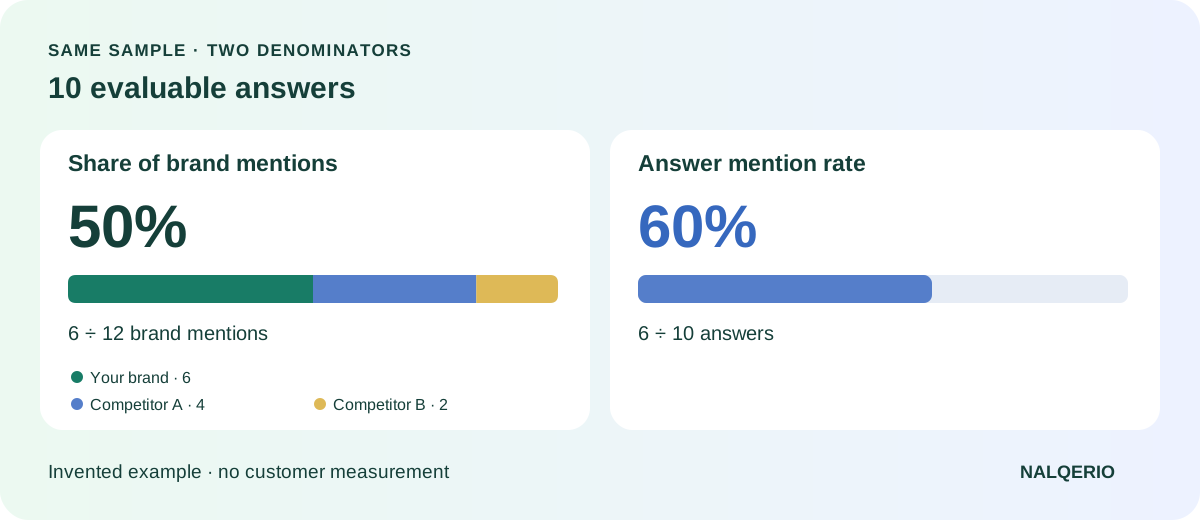
A worked example: 60% mention rate, but 50% share of voice
The following numbers are invented calculation examples, not customer measurements. We have ten evaluable answers to open supplier questions. Our fictional brand, LindenPlan, appears in six answers; competitor A appears in four and competitor B in two. Several brands can occur in the same answer.
| Brand | Answers mentioning the brand | Share of the 12 brand mentions |
|---|---|---|
| LindenPlan | 6 | 50.0% |
| Competitor A | 4 | 33.3% |
| Competitor B | 2 | 16.7% |
AI share of voice: 6 ÷ (6 + 4 + 2) × 100 = 50%. Answer mention rate: 6 ÷ 10 × 100 = 60%. The first figure describes the share of observed competition. The second says how many evaluable answers contained your brand.
Use the example below to change the competitors while keeping your own count at six. If their combined mentions fall from six to two, your share rises from 50% to 75%. Your brand has not appeared in any additional answers. Read both measures alongside the raw counts.
Share of voice in the selected brand set
6 / 12 own mentions out of all recorded brand mentions
Your answer mention rate
6 / 10 answers mentioning your brand out of evaluable answers
This calculator explains two denominators. It does not measure a website, predict demand or replace the original answers.
Which questions and competitors make a fair comparison?
Start with a concrete customer situation, such as scheduling software for independent garages in Germany. Select open questions about solutions, comparisons and important requirements. A question containing your brand name tests brand knowledge; an open supplier question tests whether the system brings you up independently. Keep those groups separate.
Confirm competitors against the same task and audience. An industry publication can be a source without selling an alternative to your product. Adding another brand later changes the denominator. Label that change and start a separate comparison series rather than silently attaching the new percentage to the old chart.
- Keep the exact questions, language and target market unchanged.
- Use the same competitor set and name-matching rules.
- Record provider, measurement environment, period and evaluable answers.
- Expose failures and method changes.
An OpenAI API answer is not a direct observation of your personal ChatGPT interface. Different API systems may also produce different samples. Compare within a consistent environment first. The Nalqerio methodology and metric definitions explain these boundaries in more detail.
How does SEO share of voice differ from AI share of voice?
SEO share of voice often uses a fixed keyword set. A tool may weight search demand, ranking positions and assumed click-through rates to estimate visibility. The exact calculation depends on the provider. Simply counting keywords on page one produces a different measure.
Consider a fictional SEO model that assigns your website 120 visibility units out of 600 across the included websites. Your calculated share is 20%. These units deliberately do not represent actual visitors. Without the weighting method and keyword set, placing another tool’s percentage beside it is not a fair comparison.
Our AI example instead counts observed brands in stored answers. It uses neither search volume nor an assumed click curve. A brand may be visible in traditional results and absent from a particular AI sample, or the reverse. Each observation needs its own evidence.
GEO vs SEO explains the two areas of work. For Google AI Overviews and AI Mode, Google Search Central says the established SEO foundations still apply. A high share in an API sample does not establish a placement in either Google feature.
Does a mention also mean a citation, a visit or a customer?
No. An answer may name a brand without linking its website. A page may also be cited without the brand name appearing in the answer text. Record brand mentions and cited domains separately. A website visit requires an actual click; a registration or purchase is a further step.
Similar metric names do not make their denominators interchangeable. Microsoft describes Citation Share in Bing Webmaster Tools as a site’s proportion of all citations for the same grounding query. That is a different pool from selected brands in API answers. Microsoft’s measure does not represent traffic share or expose a list of competitor domains.
There is no universal good SoV percentage for every business. A narrow niche with two alternatives is not comparable to a broad software category. Check which question matters commercially and what the actual answer says about your offer. A negative or inaccurate mention is not a success simply because it enters the numerator.
What GEO task should follow a competitor comparison?
Move from the percentage back to a relevant answer. Suppose competitor A appears for a question about garages with several locations while your product is absent. First check whether your product genuinely supports that use case. If it does, does the relevant product page explain the requirements, limits and practical examples clearly?
| Observation | Check first | Possible task |
|---|---|---|
| Competitor appears for a relevant use case | Original answer and available sources | Close an evidenced information gap on the responsible page |
| Your brand is described inaccurately | Product facts and identity | Correct the contradiction and link the official evidence page |
| SoV rises while your mention count stays flat | Competitor counts and data coverage | Explain the cause in the report without claiming additional reach |
| No evaluable answer is available | Error status and measurement availability | Resolve the data gap before rewriting content |
Document the change you actually publish, then compare later results under compatible conditions. Several factors may change an answer; a single before-and-after pair is not proof of an effect. The GEO optimization workflow helps you implement an action. Use a separate GEO audit for technical barriers.
Keep business outcomes alongside these observations. A growing competitive share is a signal to investigate. You still need separate evidence of qualified visits, trial users and subscriptions.
For business outcomes, add the separate view of AI referrals and registrations. The Bing guide explains website citation data in another measurement system.
Try AI brand monitoring with Nalqerio
Nalqerio connects customer questions with stored API answers, brand mentions, confirmed competitors and available sources. Its competitive share uses your brand and confirmed competitors within the evaluable sample. Repeated spellings of the same competitor brand in one answer do not count multiple times.
The competition and sources product tour shows the workspace. The GEO tool overview of AI brand monitoring explains the product scope; use the tool checklist to compare offers.
The free trial includes one project, three customer questions and one complete OpenAI snapshot in total. Fourteen days start with your first project, with no card and no automatic subscription. The trial provides a baseline; automatic repeats and exports are not included. Compare the current plans for ongoing monitoring and the providers included in each plan.
Before counting mentions, inspect each observation. The brand mentions guide distinguishes a name, backlink and source citation, helping you avoid mixing different types of evidence in the same numerator.
Frequently asked questions
How is AI share of voice calculated?
In this guide, divide your brand mentions by mentions of your brand and the selected competitors, then multiply by 100. Count each brand at most once per evaluable answer. Questions, systems and the competitor set form part of the definition.
What is a good share of voice?
There is no universal target. Competitor selection, customer questions and measurement environment change the basis. Compare a consistent sample over time and read the original answers.
Can share of voice rise without additional mentions of my brand?
Yes. Fewer competitor mentions can increase your relative proportion while your own absolute count remains unchanged. Always show the numerator and denominator.
Is share of voice the same as mention rate?
No. Answer mention rate divides answers containing your brand by all evaluable answers. The share of voice calculated here divides your brand mentions by mentions of all included brands.
Is 0% the same as not calculable?
No. Zero own mentions with some competitor mentions gives a 0% share. If no included brand is mentioned, there is no positive denominator and the proportion is not calculable.
Sources and further reading
- AdVision: Share of voice and the classic formula
- Microsoft: Citation Share and metric boundaries
- Google Search Central: AI features and SEO foundations
- Nalqerio: Metrics and comparability
Methods, product scope and sources reflect the publication date shown. Examples are not measurements of your website. Linked product pages provide current plan and provider details.
