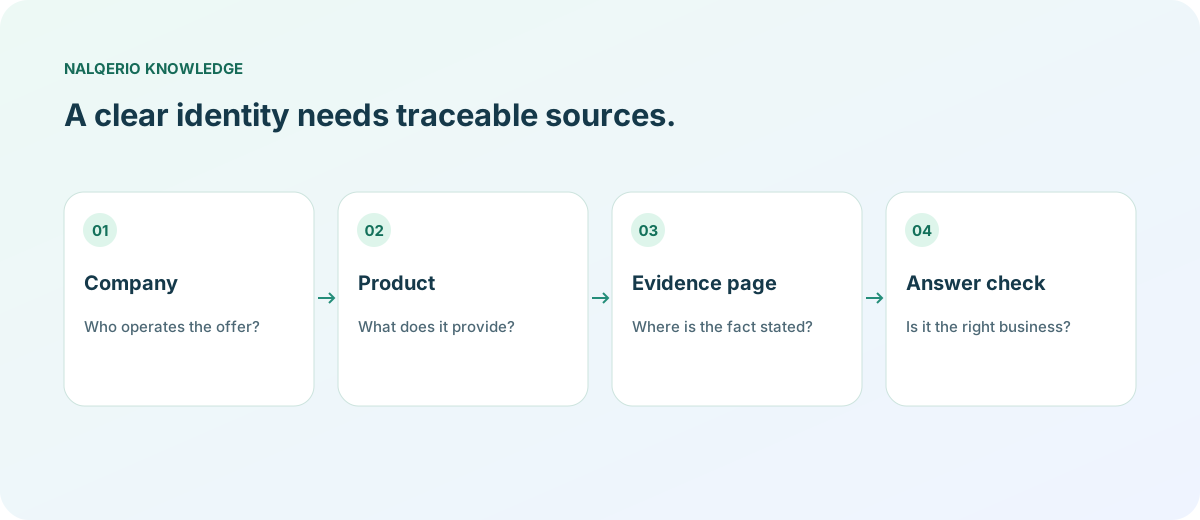
Distinguish the company, brand and product. Give important facts an authoritative page on your own website, reconcile existing official profiles and investigate mistaken identities. A correct name alone is not evidence that an answer describes the right business.
What does entity SEO mean?
An entity is an identifiable thing, such as a company, product, brand or place. “Atlas” on its own is ambiguous. A website, industry and location help establish which Atlas a page describes. Entity SEO is the work of making those identities and relationships understandable.
A keyword and an entity do different jobs. The keyword expresses what someone searches for; the entity is what the page is about. A useful page answers the searcher's question while making the relevant business and offer clear. Adding the company name twenty times will not fix an unclear product description.
This guide focuses on business identity. Our LLMO guide covers broader work on answer-ready information. A knowledge graph is also not simply a list of keywords you upload to obtain a place in search.
An entity SEO example: the company is not the product
Consider the fictional company “Lindenwerk Software” and its workshop scheduling product, “LindenPlan”. A homepage that says only “Lindenwerk: planning made simple” leaves basic questions unanswered. Is that the product name? Who runs it? Which type of business is it designed for?
| Entity | Verifiable fact | Responsible page |
|---|---|---|
| Lindenwerk Software | Develops and operates LindenPlan | Company information |
| LindenPlan | Scheduling software for independent workshops | Product overview |
| Waiting list | Sends a notification; does not book automatically | Feature documentation |
A clearer opening would be: “LindenPlan is workshop scheduling software from Lindenwerk Software.” Use your actual facts, not these example names. Follow that sentence with the product's scope and a link to its features. A compelling brand story does not compensate for inconsistent ownership information.
If a product has genuinely changed names, explain that history where it helps customers. Do not invent aliases merely to cover more search terms. Keep legal supplier details accurate while making the public product relationship easy to follow.
The semantic search guide shows why identical words can refer to different things and which context an explanation needs.
Reconcile the profiles you actually operate
Open the official profiles you use, such as LinkedIn and an industry directory. Check the website link, spelling and description against your own pages. An abandoned profile pointing to a retired product can create confusion even when the main website is correct.
For each discrepancy, record the old information, the correct fact, a supporting page and who can change the entry. Request a factual correction from third-party publishers. Profiles do not need identical marketing copy; they need compatible facts. Prioritize an incorrect product or provider over harmless differences in wording.
Google's Organization documentation describes structured business information. The sameAs property can connect relevant identity references. It should not be filled with unrelated articles or profiles that belong to someone else.
For a locally operating business, the local AI visibility guide adds checks for the location, actual service area and offer.
The real estate agency guide applies this profile review to the agency, its coverage and individual properties.
After reconciling profiles, review which results appear for the brand name. The guide to Branded Search and brand SERPs connects that inventory to the tasks behind individual searches.
Implement entity SEO in WordPress or another CMS
Start with the visible pages. Explain who provides the service on the company page and link to the product. On the product page, identify the provider and link back where that context is useful. Descriptive links help readers understand the relationship before they click.
In WordPress, your theme or SEO plugin may already generate structured data. Inspect the output before adding another block. Two conflicting Organization objects do not make the identity clearer. The schema markup guide covers implementation; this article concentrates on deciding which facts belong together.
A Google Knowledge Panel is a separate search feature. Clear information is worthwhile without a guarantee that such a panel will appear. Avoid buying invented references or a supposedly guaranteed entity entry as a shortcut.
For the editorial CMS work, the GEO for WordPress guide covers page purpose, headings, links and public settings.
Use questions that can reveal a mistaken identity
First ask a neutral identity question: “What does LindenPlan offer, and who operates it?” Then investigate a known ambiguity, such as an earlier product name. Finally, ask an open supplier question without naming the brand. Those observations answer different questions and belong in separate columns.
Record the provider, domain and location named in the answer. Open any cited URL and check the exact statement. An answer about the wrong company is a mistaken identity, even if it contains the name you track. When the origin of a claim is not visible, leave it unknown.
The competition and sources product tour shows how Nalqerio documents saved answers. Its API samples do not confirm an entry in Google's Knowledge Graph or reproduce your personal AI application. Keep that boundary explicit when comparing observations.
A clear identity does not establish evidence for a product claim. The LLM seeding source plan helps review your own facts and independent publications separately.
Choose one useful first correction
Fix the contradiction most likely to confuse a buying decision. If the product is attributed to the wrong provider, that is more urgent than adding a minor historical detail. There is no need to rebuild every page before making a clear, bounded correction.
The free Nalqerio trial provides a limited baseline for your own questions. Read the measurement methodology before interpreting the results. Check actual visits and registrations separately: a clearer identity in an answer is not evidence of a sale.
A clear identity does not yet establish that a product claim has evidence. Use the E-E-A-T evidence template for that check. When several pages cover the same task, a topic cluster with clear page roles helps organise them.
Frequently asked questions
Is entity SEO the same as keyword SEO?
No. Keywords express search demand; entities help identify the companies, products and relationships a page describes. A useful page considers both.
Do I need a Wikipedia entry?
Not for this fact-checking workflow. Start with your website and legitimate official profiles rather than manufacturing unsupported entries.
Do I need an entity SEO tool?
A small identity worksheet can be maintained without specialist software. Nalqerio documents API answers, but does not certify knowledge graph entries.
Sources and further reading
Methods, product scope and sources reflect the publication date shown. Examples are not measurements of your website. Linked product pages provide current plan and provider details.
