Local AI visibility starts with correct, consistent information about the business, offer and actual service area. Local search results and selected AI responses are separate observations. A useful location page explains a real offer rather than repeating a city-name template.
What does local GEO mean for a business?
A local customer wants to know whether a provider is reachable and suitable for the task. Relevant information includes the service, place, contact process and restrictions. A city name in the title cannot answer all of that.
Local SEO concerns public search results and business profiles among other things. GEO adds the investigation of selected AI responses. A correct profile may be useful information, but does not guarantee that every assistant will mention it. An API answer is not a complete picture of local results either.
The GEO and SEO comparison introduces the terms. This guide focuses on the local service description and a defensible set of questions.
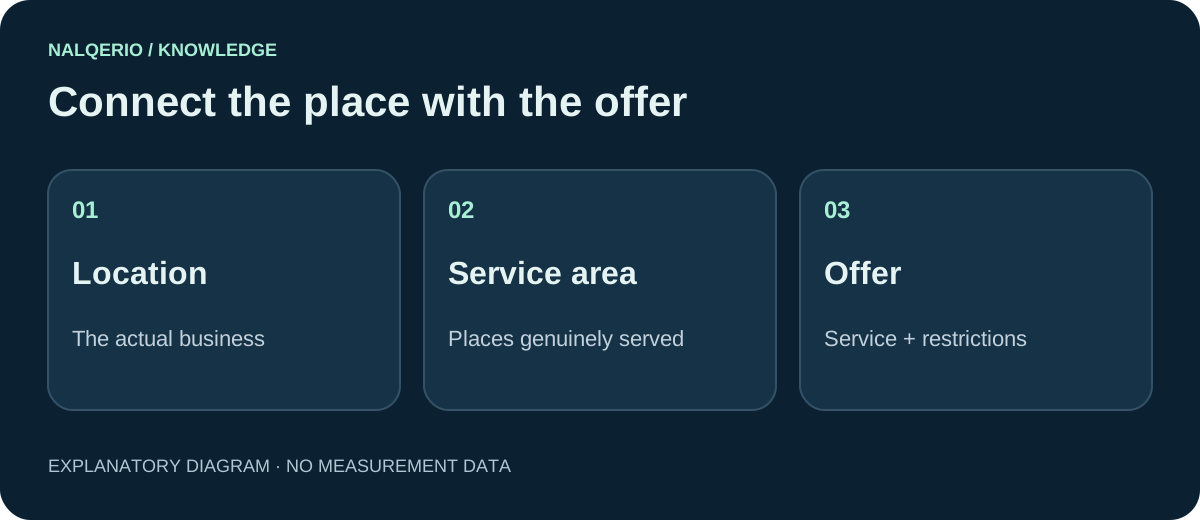
Separate the location, service area and actual offer
Prepare a facts list before drafting a location page. What is true, where is it already stated and who can verify changes? A staffed office, a postal address and a service area are different facts.
| Fact | Question it answers | Common mistake |
|---|---|---|
| Location | Where is the actual business or branch? | Presenting a virtual address as a customer-facing office. |
| Service area | Where is the service genuinely available? | Listing places where work cannot actually be provided. |
| Offer and limits | Which task is available under which conditions? | Promising emergency service when none exists. |
| Contact and hours | How and when can somebody request help? | Using old hours or an abandoned contact channel. |
| Evidence | What supports the description? | Inventing reviews, qualifications or references. |
Compare the facts with profiles you maintain. Google’s Business Profile guidelines define relevant requirements; not every business model qualifies for every listing. Do not invent an address to target another city.
Fictional example: a contractor with a defined service area
Planning example, not an actual business: Lindenwerk maintains commercial equipment in a service area that would need to be established from its real operations. “Your best partner everywhere, available any time” provides little useful detail and includes unverified promises.
A better description would identify the actual maintenance service, genuinely served places and enquiry process. It would clearly state if out-of-hours emergency work is unavailable. Real places and hours must come from business records, not a keyword list.
A suitable question could be: “Who maintains commercial equipment in [actual location], and what information is needed for a request?” The page explains that prerequisite and links to the service scope. A separate location page is justified only if it can provide distinct relevant information.
Use the briefing template and intent matrix to define the job. Remove placeholders before any real publication.
When is a separate location page useful?
A real branch with its own availability, services or contacts may justify a page. A service area that needs explanation may also matter. Twenty near-identical texts with swapped city names usually add little useful information.
Ask what local fact a visitor needs here that the main service page does not provide. Can you verify and maintain that fact? If there is no good answer, improve the existing page instead.
Link genuine locations from a clear overview and appropriate services from each location page. The topic cluster guide helps retain clear responsibilities. Google covers abusive doorway pages in its spam policies. A place name is not a substitute for original value.
Review local search and AI answers within their scope
Google identifies relevance, distance and prominence as central factors for local results. Clear information can explain relevance; it does not change the searcher’s actual location. The official local ranking explanation applies to those Google results, not every AI provider.
For an AI observation, record the place, service, language, provider and date. Separate questions about providers from questions about hours. Inspect names, areas and available sources in the original answer. A correct company name with an incorrect service area is still a problem.
Nalqerio documents selected authorised API responses and available sources. It does not directly measure Google Maps, personal ChatGPT conversations or all local Copilot results. The measurement guide explains this boundary; the hallucination guide helps investigate incorrect company facts.
Start by improving one real local offer
Take one important service in a genuinely served place. Verify the facts and answer the concrete customer question. Link to the correct service detail and contact route, then check the small-screen layout.
Record the change separately from later observations. A correct profile, accessible page or source link does not prove a new sale. The reporting template supports an honest review. To explore evidence-based AI observations, visit the product tour and current trial conditions.
Frequently asked questions
Can GEO be useful for contractors?
Accurate local service information and documented customer questions may be useful for contractors too. Visibility and enquiries still need to be observed for the actual offer.
Do I need an article for every city?
No. A separate location page needs distinct relevant information. Repeated city templates without additional value are a weak foundation.
Does Nalqerio track Google Maps rankings?
No. The observations described here concern selected authorised API responses and available sources, not direct Maps position tracking.
Sources and further reading
- Google Business Profile: local ranking
- Google Business Profile: guidelines
- Google Search Central: Link spam
- Nalqerio: methodology
Methods, product scope and sources reflect the publication date shown. Examples are not measurements of your website. Linked product pages provide current plan and provider details.
