An AI hallucination can present an invented or incorrect claim as plausible fact. In company monitoring, also distinguish outdated information, unsupported statements and confusion between entities. Record the exact claim before deciding what to correct.
What is an AI hallucination in a company answer?
Generative systems can produce convincing statements that are false or lack support. The NIST Generative AI Profile discusses confabulation as a relevant risk. For your practical review, identify the statement and its evidence before applying a broad label.
A wrong claim is not always explained by the same mechanism. A response may use an outdated source, confuse two similarly named firms or supply an unsupported feature. From the visible answer alone, you generally cannot determine exactly where the information originated.
A source link is helpful evidence to inspect, not a certificate that every sentence is correct. The grounding guide explains this distinction. Start with the individual claim, not an overall “good” or “bad” response score.
Three fictional examples of misleading company information
The following cases are invented illustrations, not measurements of Nalqerio or actual customers.
| Claim in the answer | What the review finds | Useful classification |
|---|---|---|
| “The plan includes unlimited projects.” | The current product documentation states a project limit. | False product claim; record the relevant plan and date. |
| “The office is open on Sundays.” | A linked page contains old hours; the current official page differs. | Outdated information with an identifiable source discrepancy. |
| “LindenPlan operates repair centres.” | The answer appears to mix a calendar product with a different company. | Possible entity confusion; verify names and identifiers. |
“No source was provided” is a separate finding. It does not, by itself, prove that a statement is false. Conversely, a link can be present while the cited document says something else.
A critical description is not automatically a factual error. The qualitative review of brand mentions separates tone, the specific statement and the evidence you can check.
Create a small evidence record
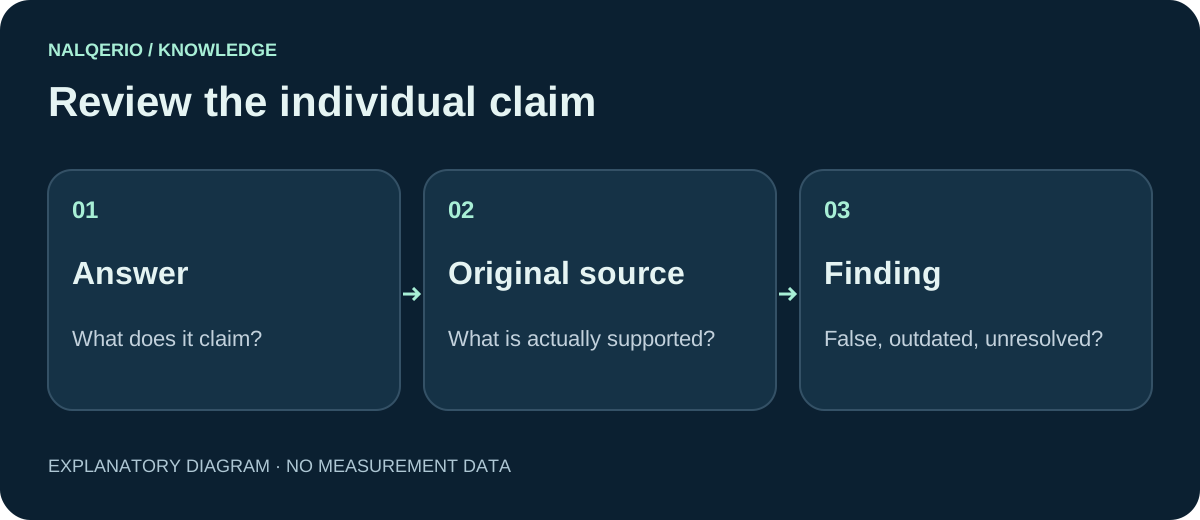
Save the exact question, language, provider, time and answer. Copy the problematic statement without changing its wording. Note any source link and whether the relevant document was actually available for review.
Add a second field containing the correct information and its supporting original source. Record version or date where needed. Finally, classify the issue as false, outdated, unsupported, misattributed or still unresolved. More than one label may apply, but the supporting explanation should remain specific.
For example: “The response says unlimited projects; the current plan page lists a limit.” That is more actionable than “AI does not understand us”. Do not attach customer information or private project data to a public correction request unnecessarily.
The reporting template helps present the finding without mixing it with traffic or sales.
Correct the information you can actually control
Check your own website first. Is the correct fact easy to locate? Do older pricing pages, FAQs and public profiles contradict it? A buried footnote may not resolve a prominent, outdated product promise elsewhere.
Update the responsible page and relevant internal references. Keep the wording precise: specify the plan, condition or time period rather than replacing one absolute statement with another. Use the content audit to locate conflicting pages.
If a third-party source is wrong, document the specific discrepancy and use its appropriate correction process. You cannot promise that a correction will be accepted or immediately reflected by an AI provider. Similar company names may also require clearer identifiers; see the entity SEO guide.
Reduce avoidable ambiguity without promising a cure
Keep core product claims, company identity and relevant dates consistent. Explain restrictions beside the claim they qualify. Make source documents usable and avoid vague superlatives that cannot be checked.
For a feature statement, ask a reviewer to verify the actual current behaviour. For an external fact, open the original source. For a draft produced with AI, verify names, numbers, references and quotations rather than assuming a polished sentence is accurate.
These practices improve the information you publish. They cannot prevent every hallucination or control a provider’s output. The E-E-A-T review offers a useful claim checklist; it does not award an automatic truth score.
Recheck under documented conditions
Keep the question and relevant conditions stable when comparing observations. Record the content change and date separately from the next answer. One corrected response does not prove that the problem has disappeared everywhere; a persistent error does not prove your update was ignored.
Nalqerio organises selected authorised API responses, mentions and available sources. It does not automatically establish factual truth or read personal ChatGPT chats. You review the original evidence and decide what needs action.
The measurement guide explains comparable observations. The product tour shows the real workflow. To investigate your own starting point, use the current conditions of the trial; recurring checks and exports depend on the plan.
Frequently asked questions
Is every unsupported statement a hallucination?
An absent source is evidence of missing support, not automatic proof of falsehood. Check the statement against an appropriate original source and keep unresolved cases unresolved.
Can I force an AI provider to correct a company answer?
You can correct your own information and use available feedback or correction channels. You cannot guarantee a provider’s response or the timing of an update.
Does Nalqerio automatically fact-check every answer?
No. It documents selected authorised API responses and available sources. The evidence still needs a claim-by-claim review.
Sources and further reading
- NIST: Generative Artificial Intelligence Profile, AI 600-1
- Google Search Central: helpful content
- Nalqerio: methodology
Methods, product scope and sources reflect the publication date shown. Examples are not measurements of your website. Linked product pages provide current plan and provider details.
