Grounding connects an AI answer to additional information, such as retrieved web pages or supplied documents. A citation alone does not establish that every statement is correct. Check the passage supporting the particular claim and the conditions under which it applies.
What does grounding mean in AI?
A language model can formulate an answer from its model knowledge. Grounding adds a connection to information supplied or retrieved for the task. That information may come from the web, internal documents or structured data.
Google’s Search grounding documentation describes one implementation: searching, processing results and returning an answer with citation information. This does not describe every Gemini interface or every API request.
For a business website, the practical question is whether important information is accessible, understandable and verifiable at its source.
The semantic search introduction explains the earlier distinction between relevant information and matching words.
Three layers: retrieved, stated and cited
Keep these observations separate when discussing GEO.
| Layer | Meaning | Unresolved question |
|---|---|---|
| Retrieval | A system accessed information. | Which parts influenced the answer? |
| Answer | A statement appears in generated text. | Does suitable evidence support it? |
| Citation display | A source link is visible. | Does the destination support that exact claim? |
Your page may be cited without your brand being named. Your brand may be mentioned while the citation points elsewhere. The brand-mentions guide explains the distinction.
No visible link does not prove a page was never processed. It means that particular evidence is unavailable to you.
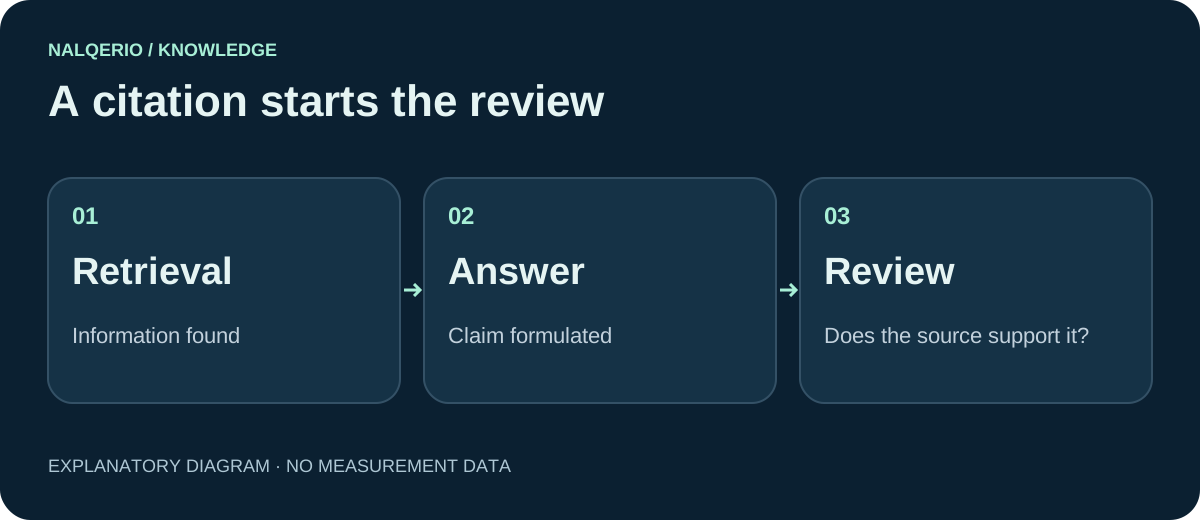
Check a claim about automatic trial measurements
Invented example, not a real AI answer: an answer says a software trial repeats measurements daily. Its citation points to a pricing page that only promises one complete snapshot.
The source is relevant to the topic but does not support the statement. Open the exact link, find the relevant passage and check the plan, date and limitations. Record the mismatch rather than treating it as a confirmed feature.
- Retain the exact claim.
- Open the source actually provided.
- Read the supporting passage in context.
- Record supported, contradicted or unclear.
For Nalqerio, the current trial and plan conditions are the relevant reference. A third-party summary cannot replace them.
For an incorrect company claim, the AI hallucination guide adds a record of the statement, contrary evidence and correction.
Grounding, RAG and SEO
Retrieval-Augmented Generation, or RAG, retrieves information for use in generating an answer. Grounding more broadly describes the answer’s connection to an information basis. The terms overlap, but are not interchangeable in every system.
This does not mean your website must provide a vector database or a special “grounding page.” Start with reliable product information, clear sections and sensible internal links. The chunking guide covers sections; the crawler guide covers access.
A publicly readable page is not guaranteed to be retrieved or cited for a particular request.
Apply the distinction to product information
Check claims whose incorrect repetition would matter: price, scope, requirements and limitations. Name the subject explicitly. “Included in this” may be unclear without the preceding paragraph.
Place conditions beside the claims they qualify. A trial allowance belongs near the trial offer. Link to the maintained detail page and correct contradictory older descriptions.
The product-evidence worksheet and content audit provide practical steps. These improve clarity without guaranteeing source selection.
Document only what you can actually observe
Retain the question, time, system and original answer. Review available citations individually. Nalqerio observes selected authorised API answers, rather than personal conversations or direct Google AI Overview results.
Keep provider environments separate. The Gemini and Perplexity guides explain relevant boundaries. A citation in one environment does not establish the same result in another.
Start with one important claim and follow it through to its source. That often reveals a clearer next action than a long list of source domains.
Frequently asked questions
Does grounding prevent all incorrect answers?
No. Retrieved information may be outdated or unsuitable, and an answer may misrepresent it. The claim-to-source connection still needs checking.
Does my website need a special grounding page?
Not for this editorial workflow. Start with accessible, understandable and current information on the responsible pages.
Is a citation a recommendation?
Not necessarily. It may support a definition, limitation or criticism. Read both the statement and the destination before describing it as endorsement.
Sources and further reading
- Google AI: Grounding with Google Search
- Google Search Central: AI features and your website
- Nalqerio: methodology
Methods, product scope and sources reflect the publication date shown. Examples are not measurements of your website. Linked product pages provide current plan and provider details.
