E-E-A-T means experience, expertise, authoritativeness and trustworthiness. It is not a standalone Google ranking factor or a public score you can calculate. The practical question is whether readers can identify who is responsible for a claim, what supports it and when it applies.
What does E-E-A-T mean for SEO?
E-E-A-T stands for Experience, Expertise, Authoritativeness and Trustworthiness. Google explains the concept in its guidance on helpful content. E-E-A-T itself is not an individual ranking factor. A checklist can organise your editorial work, but it cannot calculate a Google score.
For a business website, try this test: could a reader understand and check the claim without already knowing your brand? “Successful for years” provides little to examine. A documented process, an accountable organisation and clear conditions give the reader more to work with.
This guide focuses on the quality of your own claims. The entity SEO guide covers the consistent identity of your brand and website. The LLM seeding guide explains how to assess independent publications. These tasks complement each other, but a correct company name does not prove that a product promise is true.
Look at a product page from four perspectives
Consider a fictional appointment-scheduling product. The questions below are editorial prompts, not official scoring criteria. Open each card and look for a concrete answer on your own page.
Experience: what was actually done?
Describe a process you carried out: the starting situation, steps, observation and limitation. A real setup walkthrough says more than “intuitive design.” Only publish recordings and data you have permission to use.
Expertise: is the explanation precise?
Explain how time zones, cancellations or overlapping appointments work. State when a special case is unresolved. A clearly explained limitation can be more useful than another broad assurance.
Authoritativeness: who provides context?
Look for relevant independent sources. A review based on the reviewer's own examination has a different evidential role from a copied product description.
Trust: can I check the conditions?
Can readers find current prices, allowances, contact details and responsibility? Do the product, help and pricing pages agree?
You do not need a certificate for every sentence. You need enough reliable information for the particular decision. Do not invent customer references, awards or expert biographies to fill an empty field.
Before and after: make one promise verifiable
Suppose a page says: “Our GEO tool shows your visibility everywhere in AI.” The sentence leaves the environment, scope and limitations undefined. A more useful explanation starts with what is actually observed.
| Too broad | More verifiable | Relevant evidence |
|---|---|---|
| “Visibility across every AI” | Examine selected API answers to a defined set of questions | Named environment and documented original answer |
| “Transparent results” | Trace a mention to its answer text and available source URL | A reproducible walkthrough with labelled example data |
| “Try it free” | State the duration, included allowance and how the trial ends | Current trial terms and registration process |
For Nalqerio, you can compare the measurement methodology, product tour and plans and allowances. “API answer” is an essential part of the description. It does not promise an identical result in someone's personal ChatGPT conversation or in Google AI Overviews.
Write the revised sentence so it makes sense on its own, then put the supporting reference nearby. A source list at the bottom cannot resolve an ambiguous promise further up the page.
A reusable evidence template for your next edit
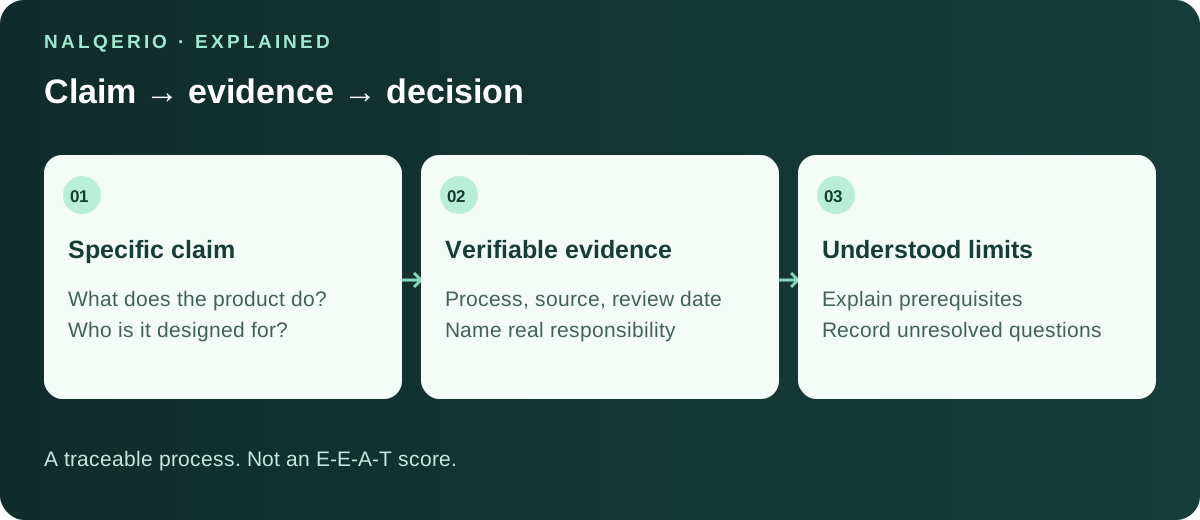
Choose an important product page and copy its three strongest promises into a working document. Complete these fields for each promise. A simple table is enough; no extra software is required.
- Claim: what should the reader understand as a fact?
- Evidence: which document, reproducible process or authorised observation supports that exact sentence?
- Scope: which plan, period, market or use case does the statement cover?
- Ownership: who keeps it accurate, and how can someone report an error?
- Review date: when was the information actually checked? Change the date after a substantive review.
For example: “The trial ends without an automatic subscription.” The evidence is the current trial terms and the actual registration process. The person responsible for the offer owns the wording. If the terms change, the product, pricing and help pages need to be checked together.
If the evidence field stays empty, narrow the claim or remove it. Repeating an unsupported statement on three pages you control does not produce three independent confirmations. Keep unanswered questions in the working document rather than smoothing them away in the published text.
Show authorship and experience honestly
Readers should be able to identify who is responsible for a guide. A business can publish through its actual editorial team or organisation. An invented specialist with an invented biography does not make the information stronger. State genuine responsibility and provide a relevant way to make contact.
Describe your work accurately. “We checked these three settings” makes a different claim from “our study proved this.” A case study needs a documented starting point, period, method and limitations. When you do not have one, a clearly labelled worksheet can still help readers complete a task.
When AI assists with writing, a disclosure does not replace checking the claims. Review figures, product capabilities, sources and legal statements through a clear control process. Do not make an unsupported statement sound certain merely to keep a paragraph fluent.
Structured data can describe information that is visible on a page. It cannot create expertise. The schema markup guide explains the distinction between accurate content and its technical annotation.
The digital PR workflow explains how checked expertise can become an accessible original resource.
How does E-E-A-T relate to AI visibility?
A documented product explanation can help people understand your offer. Whether a particular AI system later finds, selects or cites the page is a separate question. An editorial improvement does not guarantee a brand mention.
Google's documentation for AI features in Search describes technical and content foundations. It does not establish that a self-assigned E-E-A-T score triggers inclusion. Assess the quality of the page separately from an observation of a particular answer.
In practice, record a relevant customer question and its answer evidence before editing. Clarify one product claim. Later, examine the answer again under comparable conditions and read the original text. A change could also involve other sources or a model update; timing alone does not establish causation.
The AI visibility measurement guide explains how to define the sample. If the page cannot be fetched, start with a GEO audit instead. Technical accessibility and editorial evidence are different checks.
Which change should you make first?
Start where missing information makes a real decision harder. For software, that might be the trial allowance. For a service, it might be what the engagement includes and excludes. Another paragraph about “outstanding quality” usually does little to resolve either uncertainty.
- First: correct inaccurate or contradictory statements.
- Next: connect important promises to relevant evidence and limits.
- Then: check responsibility, currency and the next useful link.
Keep the first pass manageable: one page, three claims and one relevant piece of evidence for each. Record unresolved points. This gives you a reviewable improvement even when a change in search visibility takes longer to assess.
If you then want to examine how your brand appears in selected answers, you can try Nalqerio free. It is not a Google quality assessment. It adds a different kind of evidence: documented API responses to your chosen customer questions.
Frequently asked questions
Can I measure my Google E-E-A-T score?
Google does not provide a general public E-E-A-T score for your website. Your own checklist can reveal information gaps. It is not a Google measurement and does not predict a ranking position.
Does every business need a named expert author?
Responsibility and genuine qualifications should be understandable. A real organisational editorial byline can be appropriate. Do not invent people or credentials; describe how the content was actually produced.
Are examples useful without customer performance figures?
Yes. A clear walkthrough or an explicitly fictional worksheet can solve a specific problem. Do not present invented examples as measurements, customer outcomes or a study.
Does Nalqerio assess E-E-A-T automatically?
No. Nalqerio documents selected authorised API answers, brand mentions and available sources. You carry out the editorial evidence review in this guide on your own content.
Sources and further reading
- Google Search Central: helpful content and E-E-A-T
- Google Search Central: AI features and your website
- Nalqerio: measurement methodology and limits
Methods, product scope and sources reflect the publication date shown. Examples are not measurements of your website. Linked product pages provide current plan and provider details.
