Digital PR makes original findings and expertise accessible to relevant audiences. For GEO, this may create another verifiable source about an offer. Neither a published article nor a backlink guarantees a mention in an AI answer.
What does digital PR mean in a GEO workflow?
Digital PR connects public relations with information people can access online: a documented investigation, a specialist explanation or a practical resource. An independent editor decides whether and how to use it. Your website should provide the underlying details.
GEO adds a later observation: do selected AI answers mention the company, facts or sources involved? This is a measurement question, not a promise to a journalist. A resource can help readers without appearing in your selected responses.
The LLM seeding guide explains the broader terminology. Here we focus on preparing one defensible publication. If nobody can yet supply reliable information, begin with research rather than a distribution list.
Choose a topic that serves somebody else’s readers
Check three things: is there a clear reader question, can you contribute something original, and can the main statements be independently checked? A product announcement may be news, but it does not become a market study merely by adding a chart.
| Idea | Potential use | Necessary limitation |
|---|---|---|
| Documented professional process | Helps a reader avoid an error or complete a task | Distinguish experience from a general recommendation. |
| Analysis of lawfully usable first-party data | Explains a clearly defined group | Disclose selection, time period, missing data and limited representativeness. |
| Accessible explanation of public data | Makes difficult information usable | Identify the original source, licence and your calculations. |
| Unsubstantiated “market leader” claim | No verifiable insight yet | Support, narrow or remove the claim. |
A small, honestly described example is more useful than a large number without provenance. Do not publish confidential project material, customer information or personal data without an appropriate basis.
The B2B content guide helps reuse a reviewed original resource as a guide, checklist or concise explanation.
Build the original source before distributing it
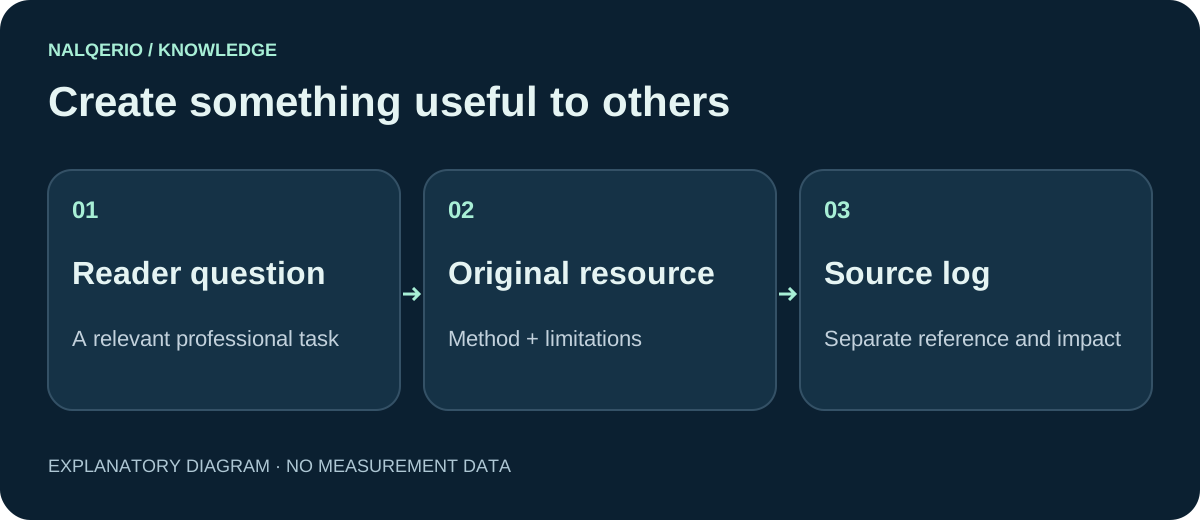
Create the public resource on your own website first. Include a clear finding, responsible authorship, date, method and limitations. For an analysis, define the sample and calculations so readers can see which conclusion follows from which evidence.
Charts need units, a time period and a meaningful reference point. Do not crop an axis to exaggerate a small difference. Explain the main finding in text as well. For a practical guide, a checked process and original example may be more useful than decorative statistics.
Use the content brief to define the assignment. The E-E-A-T evidence review helps separate demonstrable product facts from unsupported claims. Attractive presentation cannot repair a weak basis.
Worked example: a practical resource, not a fictional study
Fictional planning example: a maintenance business could prepare an illustrated checklist for requesting a service appointment. This is not an actual campaign, customer study or promised publication.
The reader question is what information to have ready before the appointment is arranged. The resource could explain model identifiers, a description of the issue and existing maintenance records. It must not turn into an unsuitable repair instruction; safety-critical work belongs with qualified people.
The brief identifies who checks the advice, which images will be taken and where instructions apply only to certain equipment. A relevant publication would be one whose readers deal with those operational questions. A random mailing list would not improve the fit.
You can use the resource without an outreach campaign: publish the checked guide and link to it from relevant parts of your own offer. The topic cluster guide helps assign it a clear role.
Distribution without purchased authority
A useful reference follows from useful information. Avoid link packages, mass keyword-link exchanges and paid placements presented as independent recommendations. Google describes manipulative practices in its link spam policies.
If you contact an editor, the information should fit that publication’s readers. A factual note with an accessible original source leaves the decision with the editor. Repeated irrelevant messages, automated comments and invented expert quotations do not create a credible reputation.
Review published information for factual errors. If necessary, document a specific correction rather than demanding a particular anchor text. The brand mentions guide distinguishes a mention, a link and a source supporting a claim.
Keep an honest record of outcomes
Maintain a source log: published URL, date, reference to your original information, factual accuracy and any link. Keep observed visits and enquiries alongside it as separate outcomes. A publication does not establish attributed revenue.
For a selected set of AI questions, you can also inspect whether available responses name the company or source. Record the provider, question, time and failures. Nalqerio documents selected authorised API responses and available sources, not all ChatGPT conversations or Google AI Overviews.
Use the reporting template to keep these findings distinct. The product tour shows the evidence workflow. The trial explains current access conditions. Start with one verifiable contribution rather than a promised reach figure.
Frequently asked questions
Do I need a large study for digital PR?
No. A small, professionally checked resource may be more useful. It needs originality, an appropriate audience and a transparent basis.
Does every backlink improve AI visibility?
There is no such general guarantee. A relevant, accurate source is useful; an individual link does not establish either an AI mention or its cause.
Does Nalqerio distribute press releases?
No. This article describes an editorial workflow. Nalqerio documents selected AI responses and available sources.
Sources and further reading
Methods, product scope and sources reflect the publication date shown. Examples are not measurements of your website. Linked product pages provide current plan and provider details.
