A GEO report documents a defined sample of AI answers and explains what it means for specific customer questions. Keep measurement conditions, observations and actions separate. Website visits and sales need their own evidence; a brand mention does not establish either.
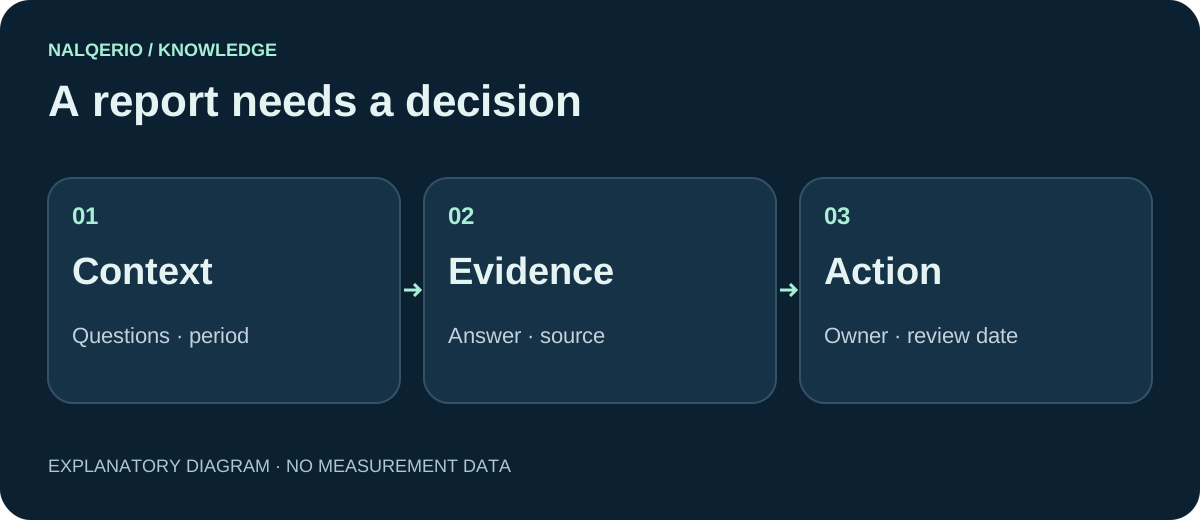
Start with the decision, not the chart
Before exporting anything, ask who will read the report and what they should decide. A business owner needs an explanation of the finding. An editor needs the affected page and the missing information. An agency client also needs an owner and a deadline.
Write one sentence at the top: “We are checking whether our offer is described accurately for three buying questions.” This gives the report a boundary. A larger list of unrelated prompts does not automatically improve it.
The public Nalqerio example report uses an explicitly fictional business. The structure below is a separate worksheet you can use in an ordinary document.
A GEO report template with seven connected fields
Copy these fields as headings. Fill in the measurement context before interpreting a percentage.
| Field | What to record |
|---|---|
| Purpose | Customer decision, audience, offer and market. |
| Period and sample | Dates, question versions, language, provider and answer environment. |
| Data availability | Planned and usable answers; failures and missing sources separately. |
| Observation | Mentions and owned citations with numerators, denominators and original evidence. |
| Comparison | A comparable earlier sample; disclose changes to the question set. |
| Interpretation | What is established, and what remains a hypothesis? |
| Next action | One target page, a specific change, an owner and a review date. |
This block can sit beside search queries, clicks and registrations in a monthly SEO report. Keep the source labels attached: Search Console and an API sample observe different things.
Worked example: a percentage needs its denominator
Fictional calculation, not a Nalqerio measurement: six questions across three providers produce 18 planned answers. Two requests fail. Four of the 16 usable answers mention the brand. The answer mention rate is 4 / 16 = 25%. Measurement coverage is separately 16 / 18.
Do not label this “25% market share.” It applies only to the chosen sample. Failed requests are not negative mentions. Owned citations need a separate denominator based on answers with usable citation data.
If you add questions next month, keep the original group separate for comparison. The methodology explains the measurement boundaries; the share-of-voice guide covers brand proportions.
Write an observation, a limitation and an action
A useful comment might read: “Our offer was absent from two examined answers about scheduling software for small teams. Their cited sources explain team permissions more clearly than our product page. We will clarify that page and revisit the same question.” This is an invented writing example.
It does not claim the content gap caused the absence or that the next measurement must improve. It proposes a task worth checking. Record changes to the product and the answer environment alongside it.
The agency monitoring guide covers the client workflow. The report still needs your judgement about the particular finding.
Keep visibility, traffic and revenue separate
A cited link does not prove a visit, and a visit does not prove a sale. Show observed answer evidence, recorded website visits and documented enquiries or purchases as separate rows.
Use the Search Console performance report for its own search metrics. The AI traffic guide covers website attribution. Unknown origins remain unknown; missing consent or referrers cannot be filled with guessed revenue.
A return-on-investment calculation would also need appropriately scoped costs and attributable returns. A visibility score is not a substitute.
Make the first report fit on one page
Choose a small fixed set of buying questions. Record the conditions, read the original answers and write one central finding, one unresolved question and one next task.
Nalqerio documents selected authorised API answers, mentions and available sources. Explore the product tour and example report, or start an individual trial project. Ongoing measurement and exports depend on the current plan.
Frequently asked questions
How often should I produce a GEO report?
Use a rhythm that provides new comparable data and completed actions. Monthly reporting is a useful working convention, not a requirement to run unnecessary measurements.
Which GEO KPI should come first?
Start with data availability: planned versus usable observations. Then show mentions and owned citations with their own denominators.
Can this become part of an SEO report?
Yes. Keep it as a clearly labelled AI visibility section alongside search performance and website analytics, preserving each source and definition.
Sources and further reading
- Google Search Console: Performance report
- Google Search Central: AI features and your website
- Nalqerio: methodology
Methods, product scope and sources reflect the publication date shown. Examples are not measurements of your website. Linked product pages provide current plan and provider details.
