A GEO strategy connects a business objective with an audience, relevant questions, verifiable content and documented observations. The 90-day plan is a working proposal, not a promise of rankings or a certain number of customers within that period.
Choose an objective beyond visibility
“Appear more often in AI” is a direction, but not a precise task. For B2B software, the objective might be to help prospects establish whether the product fits their use case and begin an appropriate trial.
Separate two observations: is the offer accurately described in selected answers, and do suitable enquiries or registrations occur on the website? The first cannot substitute for the second.
Choose one audience and offer. Covering every industry, country and buying stage at once makes the project difficult to interpret. German and English questions need their respective language and market context.
Build a small question plan
Map the prospect’s decisions: understand the problem, compare approaches, check requirements and select a vendor. Choose questions your website can answer truthfully.
| Stage | Customer question | Useful content |
|---|---|---|
| Orientation | How can we simplify this recurring task? | Practical instructions |
| Selection | Which approach suits our team? | Requirements-based comparison |
| Evaluation | What data and prerequisites are needed? | Product and help pages |
| Decision | What does the trial include, and what happens afterwards? | Current pricing and trial conditions |
Adapt these to your actual offer. The measurement guide supports a baseline; the competitor analysis adds alternatives.
Establish a traceable starting point
Read existing pages and record known information gaps. If examining AI visibility, retain a small defined answer sample with its conditions and original evidence.
Add existing search and website data as separate sources. Do not invent comparison values. For a new site, a valid baseline may simply be: no meaningful search history yet, pages accessible, initial questions and conditions documented.
The methodology explains observation boundaries. A GEO audit helps check technical obstacles before extensive editorial work.
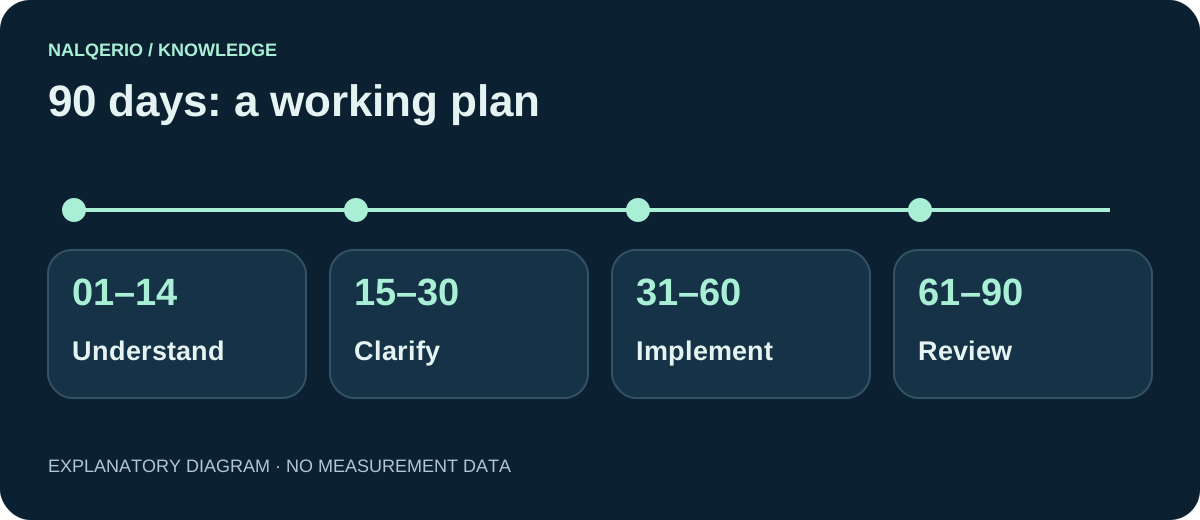
A 90-day plan with tangible outputs
These periods organise your work. Adjust them to capacity; search engines do not follow this calendar.
| Period | Focus | Completed output |
|---|---|---|
| Days 1–14 | Goal, questions and baseline | A question plan with conditions and ownership. |
| Days 15–30 | Important information gaps | Corrected product claims and a prioritised page list. |
| Days 31–60 | Targeted content and connections | Distinct answers with checked reader journeys. |
| Days 61–90 | Review and prioritise again | A report with findings, uncertainty and the next decision. |
Improving one existing page may be the right monthly task. New articles are optional. The content audit helps avoid planning another URL for an already answered question.
Define ownership and a completion criterion
Each task needs an owner, target page and checkable outcome. “Optimise GEO” is vague. “Align trial conditions on product and pricing pages in both languages” can be checked.
Budget time for maintenance: sources disappear, features change and links age. A small maintained library is more useful than many neglected pages.
The optimisation guide covers concrete page changes; topic clusters connect related tasks. Your strategy determines which action now serves the objective.
For an individual writing assignment, use the briefing template to record the reader task, required evidence and acceptance criteria.
Continue, change direction or stop?
First verify that the planned changes are complete and accurate. Then examine suitable enquiries, search data and comparable answer observations. “Insufficient evidence yet” is a legitimate finding.
Continue work that addresses a relevant problem. Change the plan if the questions miss your offer. Stop producing pages whose only purpose is another keyword variant.
Use the GEO reporting template for the decision. Nalqerio can document selected API answers and available evidence. Explore the product tour before starting a trial.
Frequently asked questions
Does GEO replace SEO?
The tasks often complement each other. Accessible pages, helpful information and clear reader journeys remain useful, while the observations and measurement methods differ.
Do I need new articles every week?
No. Choose work according to an unresolved customer task. Correcting an important product page may be more useful than another introductory article.
When will the strategy produce customers?
No fixed deadline can be promised. Demand, the offer, competition and the customer journey all matter. The working plan is not a revenue forecast.
Sources and further reading
- Google Search Central: helpful, reliable, people-first content
- Google Search Central: AI features and your website
- Nalqerio: methodology
Methods, product scope and sources reflect the publication date shown. Examples are not measurements of your website. Linked product pages provide current plan and provider details.
