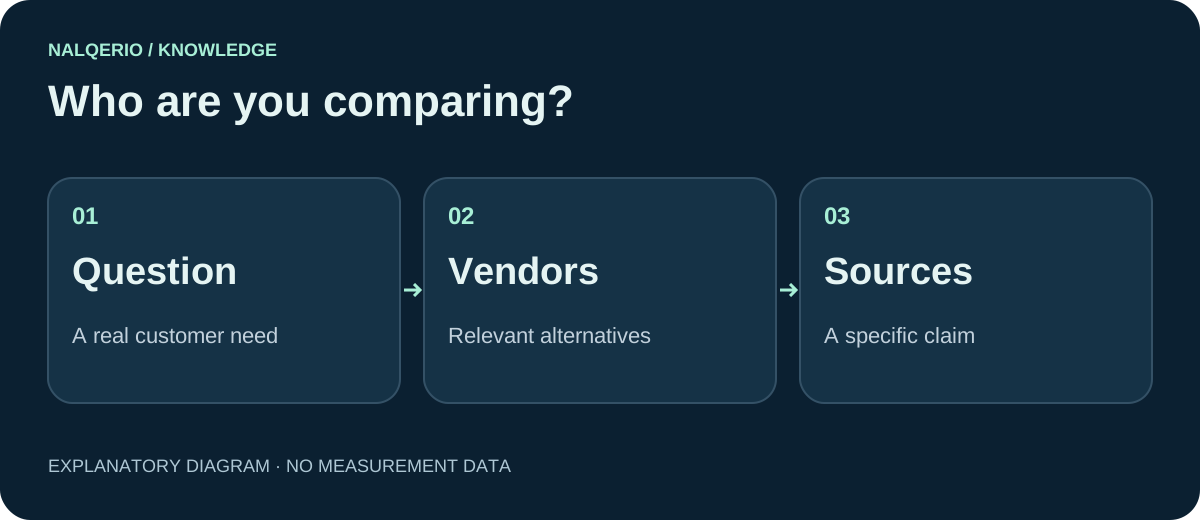
Useful competitor analysis separates competing businesses, search results and cited sources. Compare the same customer questions under documented conditions. A recurring name can reveal a content gap; one answer cannot establish market leadership.
Which competitors belong in the analysis?
Start with three to five businesses your customers could realistically choose. Check their offer, audience, region and price range. A much broader enterprise product may appear in an answer without being your most useful comparison.
Keep observed names in a separate list until you classify them: direct vendor, alternative solution, publisher, directory or unclear. A comparison website may be a source about the market rather than a competing product.
Read the offer page and the cited passage. A similar name is not enough. The brand-mentions guide helps establish identity and context.
Compare customer decisions, not just brand names
“What is Brand A?” naturally centres Brand A. An open comparison starts with a decision, such as “Which scheduling software suits a small team with changing work hours?” Add requirements that matter to real customers.
Record the language, market and exact wording. A neutral selection question and an explicit comparison of named vendors are both useful, but answer different research questions.
Try an orientation question, a selection question and a common objection. The query fan-out guide helps break a broad decision into concrete subquestions.
For B2B offers, also check whether the compared suppliers serve the same business buying decision.
Use a matrix that retains the evidence
Create one row per question, provider environment and observation time. This is a worksheet, not a ranking or a real measurement.
| Field | What to check |
|---|---|
| Customer question | Which decision and requirements? |
| Your brand | Named? Described accurately? Supported by which evidence? |
| Other offers | Which names appear, and are they relevant alternatives? |
| Sources | Your site, a competitor page or an independent publisher? |
| Content difference | What specific information is available there but unclear on your site? |
| Next action | Which existing page can address the real gap? |
Retain the original answer or an authorised excerpt and the available source URL. When a source is unavailable, say so. Do not add a URL found in a separate search as though the answer had cited it.
Read SEO findings and AI answers side by side
A conventional SEO analysis examines search results, intent and recorded queries for your own site. An AI analysis examines a particular answer and its available evidence. Keep separate columns.
Search Console reports on your own property. It does not reveal competitors’ actual visitor or sales data. Third-party traffic estimates are not their analytics records either.
If a competing page appears in both investigations, inspect its explanation and evidence. Do not assume a causal relationship. The GEO versus SEO guide explains the different observation spaces.
Turn a competitor finding into your own improvement
Fictional example: an agency examines scheduling software for small practices. An answer names Vendor B and cites its explanation of team permissions. Your own page only promises “flexible collaboration.”
The useful task is to check your actual permission features and explain setup, limits and a verifiable example. If the capability does not exist, do not invent it. Your product may simply be less suitable for that requirement.
You can later examine share of voice within a defined sample. Keep the individual evidence: frequency alone does not explain a purchase decision.
Choose a gap that matters commercially
Ask whether the gap affects a real buying decision, whether you can answer it honestly and whether an existing page is suitable. Missing contract conditions may matter more than another general paragraph about GEO.
Use the content audit to choose the page and the reporting template to record the action.
Nalqerio connects selected API answers with competitor and source evidence. It does not reproduce personal chat histories or replace a conventional search ranking database. Explore Competition & Sources in the product tour or start a trial project.
Frequently asked questions
How many competitors should I compare?
Start with a few relevant alternatives that reflect a real customer decision. A long list is not automatically more informative.
Is every cited website a competitor?
No. A publisher, directory or documentation page may be a source without selling a competing offer.
Does this explain why ChatGPT prefers a vendor?
It establishes observed answers and available evidence. These support testable hypotheses, not complete knowledge of a system’s internal selection process.
Sources and further reading
- Google Search Console: Performance report
- Google Search Central: AI features and your website
- Nalqerio: methodology
Methods, product scope and sources reflect the publication date shown. Examples are not measurements of your website. Linked product pages provide current plan and provider details.
