LLMO means Large Language Model Optimization. The term is used inconsistently. Separate model knowledge, retrieved web sources and the answer formulated from that context. This produces practical website tasks rather than control over training or recommendations.
What does LLMO mean?
LLMO describes measures intended to make information more understandable or discoverable for language-model-based systems. It often overlaps with GEO. The term does not establish a universal list of LLMO ranking factors.
A concrete business goal is more helpful: Is the offer represented accurately? Are appropriate sources cited? Does the brand appear for selected supplier questions? Our GEO and SEO comparison puts those goals alongside conventional search.
Treat promises such as “We will put your brand into the model” critically. Publishing a website is neither a targeted training instruction nor guaranteed inclusion in future model knowledge.
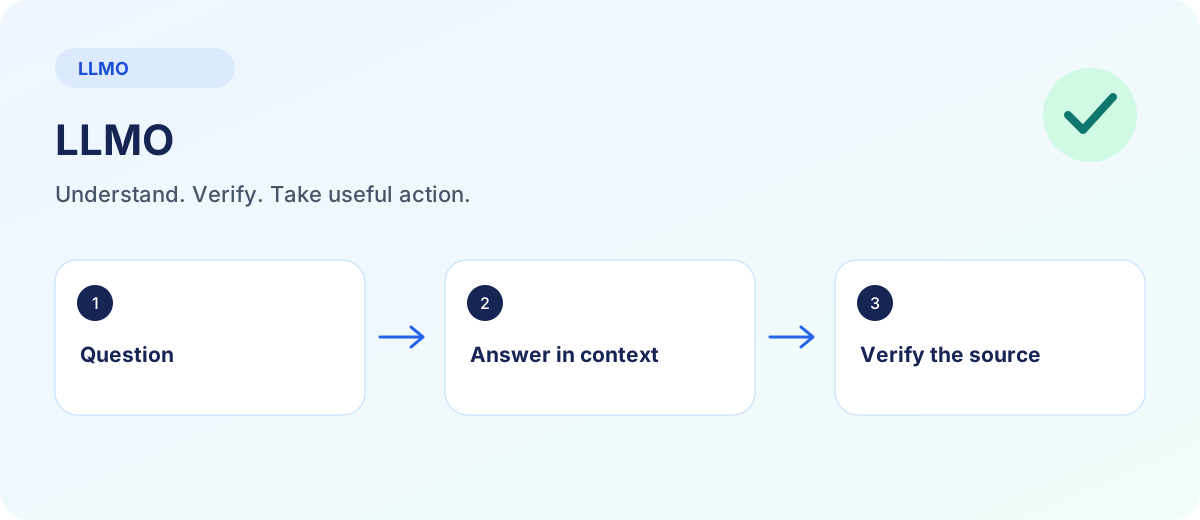
Three layers to keep separate
| Layer | What happens? | What can you examine? |
|---|---|---|
| Model knowledge | The model uses learned patterns that may be outdated | Is a statement made without an identifiable current source? |
| Source retrieval | A system searches for or fetches additional material | Which URLs or evidence are visibly cited? |
| Answer formulation | The system writes an answer using available context | Is the statement correct and is its source used appropriately? |
An answer can be incomplete or wrong even with web retrieval. A visible source link initially establishes only that the link was supplied. Open it and inspect the context. Without a visible link, you cannot simply determine which individual page caused a statement.
For practical source review, the ChatGPT SEO and Perplexity SEO guides apply this distinction to specific questions.
Make it clear which business you mean
Use your brand name consistently. Explain on the responsible product or company page what you offer, who it serves and its limitations. When names are easily confused, a clear description helps more than repeating the name.
Maintain verifiable facts: product name, supplier, available features, supported markets and contact details. Align them with existing public profiles. Distinguish actual integrations from roadmap ideas.
Structured data can describe visible information in a machine-readable form. It replaces neither the information nor independent evidence. Do not invent reviews, references or awards to create an apparently stronger entity.
Use the entity SEO worksheet to distinguish the company, brand and product. An existing Google Knowledge Panel has its own correction process.
Write for a question a person wants to resolve
A fictional buyer asks, “Can I share results with my client?” A useful page explains which sharing options exist, which plan includes them and who receives access. “Collaboration reimagined” does not answer the question.
Build the section around a short answer, conditions, an understandable example and a link to the appropriate help. Use necessary terminology and explain it. Remove sentences that could describe any company after changing the name.
Internal links should answer a specific follow-up question. A plan allowance leads to pricing, a workflow to instructions and a technical limitation to methodology. The optimisation guide demonstrates the revision process.
Review sources rather than manufacturing reach
If another website misrepresents your offer, first consider whether you can send the responsible editor evidence of the error. Do not buy invented reviews or present your own promotional writing as an independent evaluation.
Whether a system may fetch your website also depends on its access rules. Search crawlers, training crawlers and user-initiated fetchers serve different purposes. The crawler guide explains them.
An llms.txt directory can guide agents to documentation. It does not change model weights, force citations or replace useful public pages.
Review your next improvement
Nalqerio helps record selected API answers and their evidence. It does not measure the knowledge of every model or reproduce every chat interface. The measurement methodology explains what a sample can establish.
Start with the measurement guide, then test your own questions if useful. An accurate product description is a valuable finding. Whether it produces customers requires separate observation of relevant website visits, trials and conversions.
Frequently asked questions
Are LLMO and GEO the same?
They are often used with overlapping meanings. LLMO emphasises language models and GEO generated answers. Define the tasks and results intended in your project.
Can website copy directly train a language model?
No. Publishing a page does not give you control over whether or when a provider uses it for training, or how a model will respond later.
Does a citation always prove a statement?
No. Check whether the cited page actually supports the particular statement. A source link may be inappropriate or misinterpreted.
Sources and further reading
Methods, product scope and sources reflect the publication date shown. Examples are not measurements of your website. Linked product pages provide current plan and provider details.
