Here, ChatGPT SEO means making your website an accessible, understandable source for relevant questions. Start with a small question set, separate answers with search from model-only answers, and fix one specific information gap. Track brand mentions, source links and actual visits separately.
What does ChatGPT SEO mean here?
People use the term in two ways. Some want prompts that help ChatGPT write SEO content. This guide addresses the other task: preparing a business website so that its information is useful when someone asks a relevant question.
An answer without web search may rely on model knowledge. An answer with search may use current web pages and provide source links. These are different observations. A correct description of your product does not prove that your website was retrieved. Open the sources instead of inferring access from the answer.
For the broader relationship with conventional search, start with GEO vs. SEO. The workflow below is for the next stage, when you have a particular page and customer question to investigate.
Choose three questions that test different things
Consider a fictional booking-software business serving small hair salons. It wants to know whether prospective buyers discover it and understand its limitations. Asking “Do you know our brand?” cannot answer both questions.
| Question | Purpose |
|---|---|
| “Which booking software suits a salon with three employees?” | Open supplier discovery without naming the brand |
| “Which booking software offers shared calendars and a waiting list?” | A specific set of buying requirements |
| “Can ExampleSalon import appointments from a CSV file?” | Accuracy of a brand-specific product fact |
The third question supplies the brand in advance. A mention in that answer is not evidence of discovery through an open question. Avoid confidential information and customer names. Record the language, market and exact wording, then keep the set stable during a comparison.
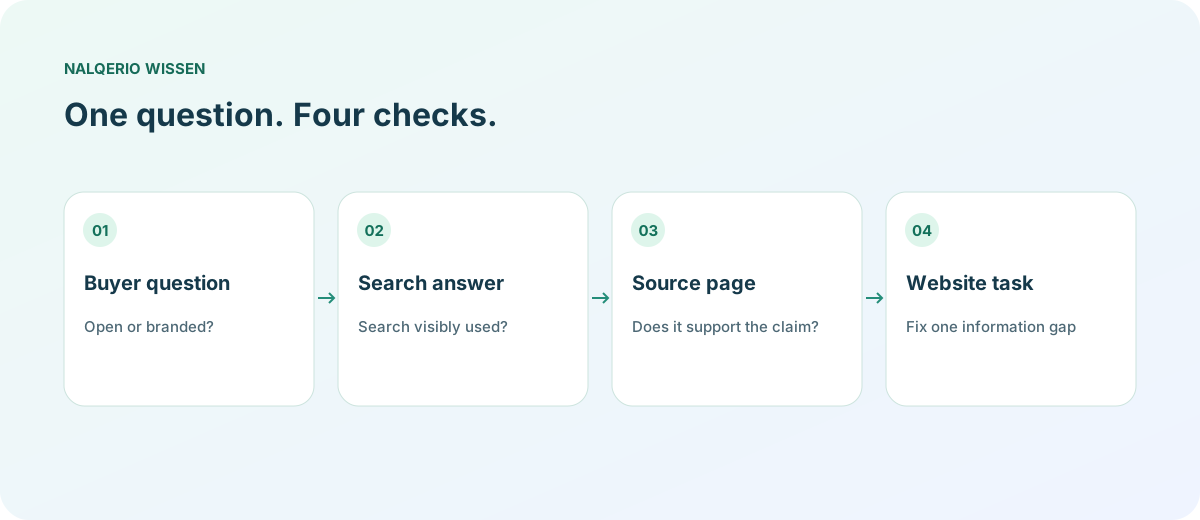
Can the relevant page actually be retrieved?
Open the destination without logging in. Is the essential information available as readable text? Does the final URL work? Does a bot challenge interrupt retrieval? When access fails, ask your technical team to examine the actual server response.
OpenAI distinguishes OAI-SearchBot, used for search results, from GPTBot, used for potential model training. Their settings are independent: permission for training is not a necessary detour to search visibility. The official OpenAI documentation also lists the published IP ranges.
Allowing access does not promise a mention. If robots.txt or firewall rules need changing, use the AI crawler guide for the technical checks. Sometimes the obstacle is retrieval rather than the wording on the page.
Store products also require variant, stock and data-delivery checks. The ChatGPT shopping guide for merchants handles that separate task. Keep measurement environments distinct when comparing Gemini answers.
Put the useful answer on the product page
A question about waiting lists does not need another general article about artificial intelligence. It needs a feature page explaining what the waiting list does, which plan includes it, and where its limitations are.
Fictional page example
A waiting list for newly available appointments
“Customers can register interest in a time window. When a matching appointment becomes available, the system sends a notification. The appointment is booked only after confirmation. This feature is included in the Team plan.”
This explanation is useful only if the feature really works that way. Add an authentic screenshot, setup instructions and a link to the relevant price. Make limitations easy to find. A reader checking the answer should reach the responsible source without guessing.
Keep closely related questions on one suitable page. Link to it from a clear overview rather than creating near-identical pages for every variation of “ChatGPT SEO optimisation”. For business identity information, appropriate schema markup can complement the visible explanation.
Inspect the answer before drawing conclusions
A screenshot with a green tick is not a complete record. Save what you actually observed: the answer, whether search was visibly used, and the exact source URL. Then check whether that page supports the claim attributed to it.
| Field | Record |
|---|---|
| Environment | ChatGPT interface or API; visible mode, date and language |
| Observation | Brand mentioned? Owned URL linked? Product fact correct? |
| Evidence | Answer excerpt and the page actually linked |
| Task | For example: explain the waiting-list limitation on the feature page |
This is a worksheet, not a test result. Later answers may differ even when the question stays the same. One change in an answer does not prove that your edit caused it. The AI visibility measurement guide explains the wider recording process.
A useful task you can complete today
The Nalqerio product tour shows how customer questions and stored answers connect. Nalqerio records API samples, which are not a copy of your personal ChatGPT interface. See the methodology for the scope.
Use the free trial to examine a bounded starting point. Afterwards, decide whether the paid monitoring allowances fit your work. A brand mention alone does not establish traffic or a sale.
Frequently asked questions
Can I submit my website to ChatGPT for a ranking?
This workflow is not a ranking submission. You can improve website access and information, but that does not guarantee whether or when ChatGPT selects it.
Must I allow GPTBot to appear in ChatGPT search?
OpenAI documents separate controls for OAI-SearchBot and GPTBot. Search access and potential model-training access are independent choices.
Does Nalqerio measure the answer I see in ChatGPT?
No. Nalqerio uses documented API samples. The personal interface can use different context, features and answers.
Sources and further reading
Methods, product scope and sources reflect the publication date shown. Examples are not measurements of your website. Linked product pages provide current plan and provider details.
