SEO for small businesses starts with three basics: Search Console, Google Business Profile and a list of real customer questions. Then each service gets its own page with a clear title. Reviews, complete directory listings and real references build trust, including with AI systems. According to Google, results usually take four months to a year.
Is SEO worth it for small businesses?
Yes, if your customers search online for what you offer. And they almost always do: for the painter nearby, the accountant for freelancers, the shop with the right product. More and more often they also ask ChatGPT or see a Google AI Overview first.
Search engine optimisation (SEO) means building your website and listings so that Google and AI systems understand what you offer, where and for whom. Unlike advertising, each visitor costs nothing afterwards. SEO needs patience, though: Google itself says it usually takes four months to a year for improvements to pay off.
The four-week plan at a glance
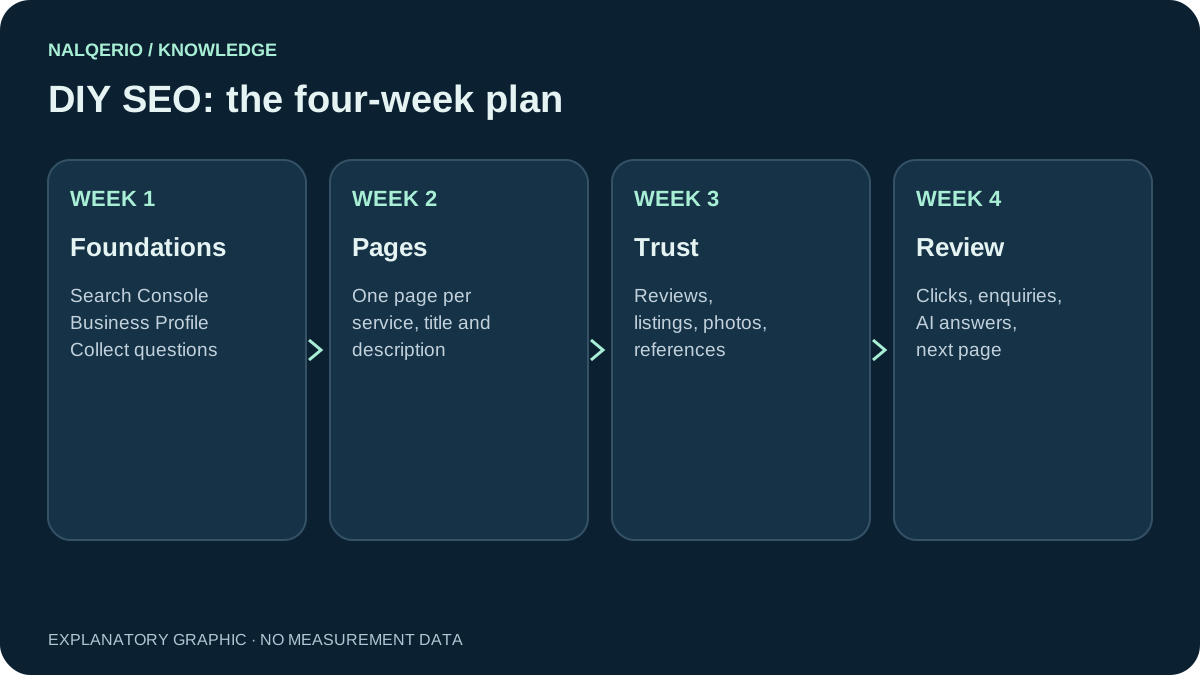
The plan is for owners who can invest about an hour a day. It follows a simple logic: first make sure Google can find you, then build clear pages, then build trust and finally check what works. The ten steps below are spread across these four weeks.

Week 1: The foundations (steps 1–3)
- Set up Search Console. Google Search Console is free and shows which searches your pages appear for, how often they are clicked and whether Google finds errors. Submit your sitemap there. Bing Webmaster Tools does the same for Bing, see Bing indexing.
- Complete your Google Business Profile. Correct category, services, opening hours, photos and a description in full sentences. The guide is at Google Business Profile.
- Collect real customer questions. Write down 20 questions customers ask on the phone or by email. Add the suggestions Google shows as you type. This list is the basis for all your pages. How to recognise the intent behind a search is shown in identifying search intent.
Week 2: Clear pages (steps 4–6)
- One page per service. If you paint facades, hang wallpaper and lay floors, you need three pages instead of one catch-all page. Each page answers: what exactly, for whom, where, how it works and roughly what it costs.
- A title and description for each page. The page title is what appears as the headline in Google. Say what you offer and where, such as “Facade painting in Bristol | Example Painters”, rather than “Home” or “Services”.
- Answer common questions directly. A short FAQ block with the questions from step 3 helps customers, Google and AI systems alike. Examples and structure are in our FAQ guide for SEO and GEO.
After: twelve short pages, each with its own title, two or three paragraphs, photos of a real job and a contact button. Google and ChatGPT can now match each service on its own.
Week 3: Building trust (steps 7–9)
- Ask for reviews. Ask happy customers right after the job, with a short link. Reply to every review. Ideas and rules are in our guide to getting Google reviews.
- Check your directory listings. Name, address and phone number must be the same everywhere. In our web agency study, Perplexity relied on directories in 17 of 20 answers. Which ones count is shown in our guide to business directories.
- Show real references. Photos, short project descriptions, customer names (with permission), memberships and qualifications. This is the part no competitor can copy.
Week 4: Check what works (step 10)
- Review the results and plan the next page. Three questions are enough: which searches do my pages appear for in Search Console? Are calls and enquiries increasing? Do ChatGPT, Gemini and Google AI Overview name me for my customer questions?
Search Console answers the first question, your phone and inbox the second. For the third, ask the AI systems your most important customer questions without mentioning your company name. The quickest start is the free AI check. Then repeat weeks 2 and 3 with the next service.
Free tools that are enough
| Tool | What for |
|---|---|
| Google Search Console | searches, clicks, indexing, errors |
| Google Business Profile | maps, local search, reviews |
| Google Keyword Planner | approximate search volume (needs a Google Ads account, not ads) |
| PageSpeed Insights | loading speed and display on phones |
| Bing Webmaster Tools | indexing on Bing, which also feeds AI search |
| Nalqerio AI check | whether ChatGPT names you for two customer questions |
Small businesses do not need expensive SEO software at the start. It becomes worthwhile when you manage many pages or want to track competitors in detail.
Common mistakes and whether you make them
Click on each mistake and check your website:
All services on one page
Google struggles to match a catch-all page to a specific search. One page per service is almost always better.
The same page for every town
Pages that differ only in the town name count as doorway pages for Google, which means spam. A location page needs real content of its own.
Different addresses across the web
Old phone numbers or different company names in directories confuse Google and AI systems.
Buying reviews
Bought or self-written reviews break Google’s policies and are illegal in many countries, including the UK and the EU.
Huge images
Photos straight from a phone make pages slow. Resize them before uploading.
A guaranteed number one
Nobody can guarantee a number one ranking on Google. Google says so itself. Be careful with offers like that.
Do it yourself or hire an agency?
You can handle the steps in this guide yourself. An agency is worth it if your website is technically outdated, you have no time for writing or you want to build many pages in a highly competitive market. Ask beforehand for references, the specific work done each month and how success will be measured.
Whether you do it yourself or hire an agency: do not measure the effect on Google alone. Nalqerio shows week by week whether ChatGPT, Gemini, Perplexity and Google AI Overview name you for your customers’ questions and which sources count. More on the differences in GEO vs. SEO.
Frequently asked questions
Can I do SEO myself?
Yes. Many owners handle the most important basics themselves, such as Search Console, Google Business Profile, one page per service and reviews. With about an hour a day you can complete the first steps in four weeks.
How long does SEO take to work?
Google says it usually takes four months to a year for improvements to have a visible effect. Business profile updates and new reviews often work faster.
How much does SEO cost for a small business?
Done yourself, mainly time, because the most important tools are free. Agency prices vary widely. Compare offers by specific work and measurable goals, not by promises.
What SEO mistakes do small businesses make most often?
All services on one page, page titles like “Home”, copied location pages, inconsistent address details in directories, oversized images and bought reviews.
Does SEO also help me get named in ChatGPT?
Often, yes. Clear service pages, a complete business profile, directory listings and reviews are also sources for AI answers. Check whether it works with fixed customer questions.
Do I need an agency for local SEO?
Not for the basics. An agency is worth it for technically outdated websites, a lack of time for writing or highly competitive markets.
Sources and further reading
- Google Search Central: SEO Starter Guide
- Google Search Central: Do you need an SEO?
- Google Search Central: Spam policies (doorway abuse)
- Google Business Profile Help: Tips to improve your local ranking
- PageSpeed Insights
Methods, product scope and sources reflect the publication date shown. Examples are not measurements of your website. Linked product pages provide current plan and provider details.
