FAQ content gives clear answers to recurring questions. Match it to the page and state relevant conditions. FAQPage markup is a separate matter: Google stopped displaying FAQ rich results on 7 May 2026.
Which questions deserve a place?
Look for uncertainty about prerequisites, setup, limits, cancellation, data migration and plan differences. Support requests and conversations can help, provided personal details are removed.
Without that evidence, start with plausible questions and label them internally as assumptions. Observe what visitors actually ask later. Search suggestions provide phrasing, not proof of purchase intent or frequency.
The customer-subquestion guide helps with discovery. Select only questions that can sensibly be answered on the particular page.
Choose the right home for the answer
Trial conditions belong near the trial or pricing page. Setup steps belong in instructions. A guide can explain terminology without repeating the same buying FAQ across every article.
| Question | Suitable location | Reason |
|---|---|---|
| Do I need a payment card? | Pricing or trial page | It affects registration. |
| How do I add my first question? | Setup guide | The reader needs a sequence. |
| What counts as a source citation? | Methodology or specialist guide | The task is understanding the evidence. |
| What are the measurement limits? | Product page and methodology | The boundary shapes expectations. |
Give changing information an authoritative home. Other pages can link to it, reducing contradictory conditions.
When several people develop the answer, a shared content brief helps clarify the question, limits and evidence first.
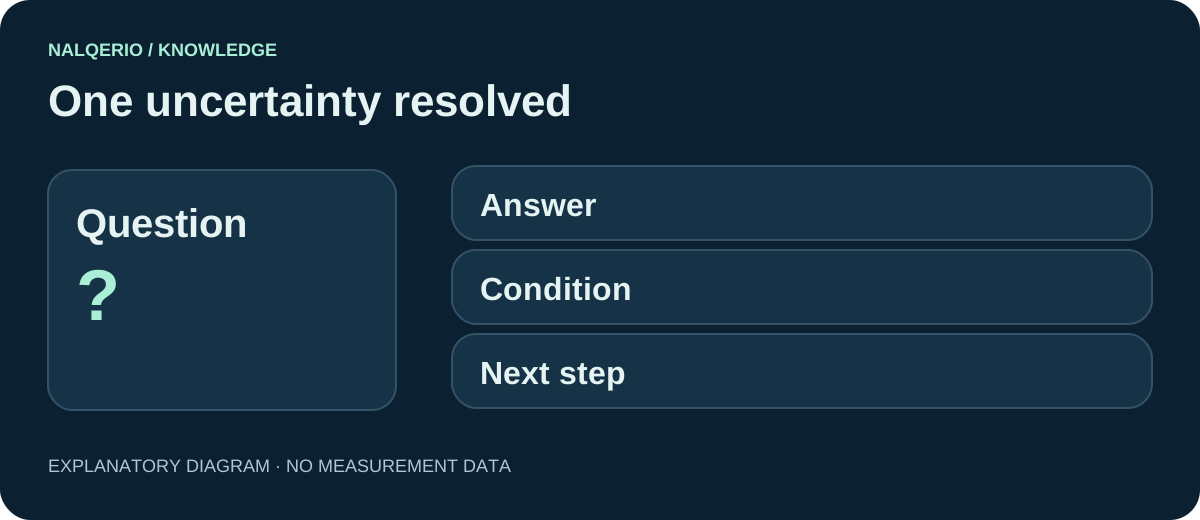
Before and after: answer the actual question
Unhelpful: “Our revolutionary solution lets you start easily and achieve optimal results.” That does not answer the payment-card question.
Specific Nalqerio example: “You do not need a card for the trial. It starts when you create your first project and does not automatically become a subscription. See the pricing page for the current allowance.”
Write the direct answer first, then the important condition or exception, then the useful next link. Do not force every answer into a fixed word count. When a question needs several steps, give an orientation and link to the complete instructions.
FAQ schema in 2026: what changed at Google?
Google’s documentation changelog records the end of FAQ rich results on 7 May 2026 and removal of the associated documentation on 15 June. Older guidance promising that display for particular website categories is outdated.
Schema.org’s FAQPage type still exists. A vocabulary type and a supported Google search feature are different things. Markup does not create demand, correct inaccurate answers or guarantee AI citations.
Keep useful visible answers. Review whether any annotation is accurate and serves a real purpose. The schema-markup guide explains the underlying distinction.
Avoid interchangeable FAQ blocks
Read each question without the surrounding article. Would a prospect ask it that way? Does the answer add information? Remove questions that merely put the same keyword into another sentence.
A question may be relevant on several pages, but a copied block of unrelated answers rarely improves the experience. Keep changing conditions linked to the maintained source.
Expandable answers need understandable controls and accessible text. Clear labels help more than decorative motion. For longer explanations, use well-defined answer sections.
Five candidate questions, three useful answers
Collect five concrete uncertainties, choose the three most relevant to an existing page and write direct answers. Verify each product condition and add only the next link the reader needs.
A content audit can reveal duplicate or outdated answers. To examine how selected AI answers describe your offer, begin with the measurement guide and product tour.
The first success criterion is whether an uncertainty is resolved. A question-and-answer format does not automatically produce rankings or recommendations.
Frequently asked questions
Can FAQ schema still produce Google FAQ rich results?
Google discontinued FAQ rich results on 7 May 2026. The Schema.org type remains, but does not promise that Google display.
How many FAQ questions should a page contain?
Use as many as the particular decision needs. Three precise answers can be more useful than twenty repetitive ones; there is no universal SEO minimum.
Can the same question appear on several pages?
Yes, where it is relevant. Keep changing conditions maintained in one authoritative place and avoid large interchangeable blocks.
Sources and further reading
- Google Search Central: Änderungen an der Dokumentation / documentation updates
- Schema.org: FAQPage
- Nalqerio: methodology
Methods, product scope and sources reflect the publication date shown. Examples are not measurements of your website. Linked product pages provide current plan and provider details.
