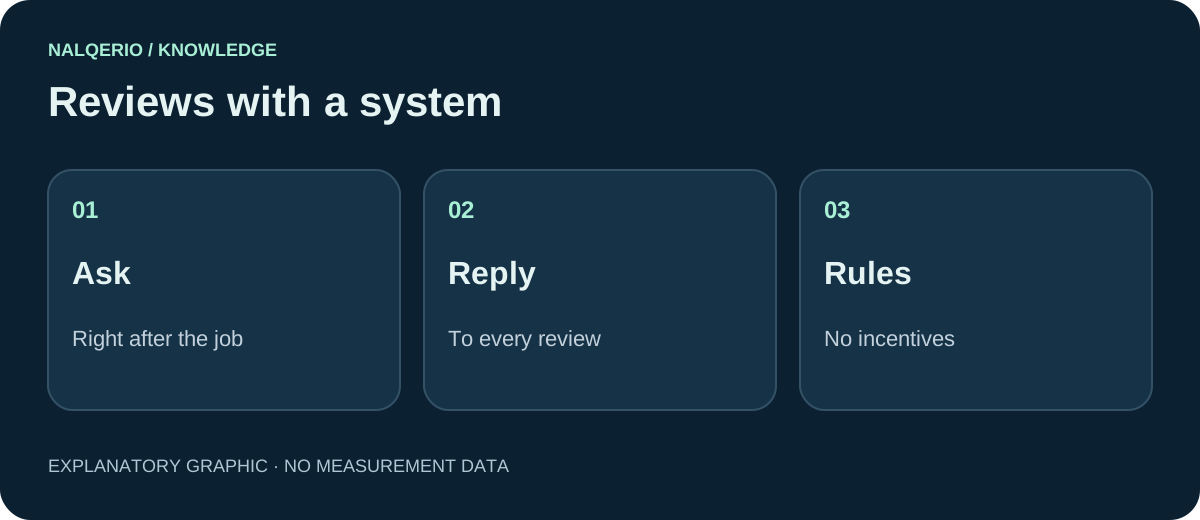
More Google reviews come when you ask right after a good experience and offer a short link or QR code. Bought or fake reviews, rewards for reviews and filtering out unhappy customers are prohibited. Reply to every review, factually and without personal details.
Why Google reviews make such a difference
Reviews are often the first thing customers see about your business. They help decide who gets the call. In its tips to improve local ranking, Google explicitly lists reviews as part of a business’s prominence.
AI assistants also often draw on review platforms for recommendations. A business with many recent, genuine reviews is easier to assess for people and machines alike.
How to ask the right way
- Timing: right after a good experience, for example at handover, after the appointment or with the invoice.
- Personal: a short, personal request works better than an automated mass email. “If you were happy, we would appreciate a short review” is enough.
- Easy: your Google Business Profile offers a share link that takes customers straight to the review form. You can turn it into a QR code for the counter, business card or invoice.
- Ask everyone: ask all customers, not only those you expect five stars from.
Note: customers need a Google account to leave a review. Do not push anyone who does not want to.
What is prohibited
Google’s contribution policy prohibits, among other things, fake content, reviews in exchange for incentives and reviews by employees or the owner. Selectively asking only happy customers in order to keep negative reviews away is not allowed either.
Consumer protection law adds to this in many countries. In Germany, for example, the annex to the Unfair Competition Act (UWG) prohibits submitting or commissioning fake reviews and misrepresenting reviews (in particular No. 23c). Bought reviews can therefore lead not only to suspension but also to legal action.
| Approach | Assessment |
|---|---|
| Politely ask all customers for an honest review | allowed |
| QR code at the counter or on the invoice | allowed |
| Discount or voucher for a review | not allowed |
| Only sending happy customers to review | not allowed |
| Buying reviews or having friends write them | not allowed |
Replying to reviews
Reply to every review. A short thank-you for positive reviews shows that you listen. For criticism: stay calm, answer factually, offer a conversation and do not mention personal data or job details. Your reply is read mainly by future customers, not only by the author.
If a review breaks the guidelines, for example because it is abusive or clearly not from a customer, you can report it in your business profile. A review you simply do not like will not be removed. More on handling platforms in review platforms.
Your weekly routine for more reviews
A fixed routine turns reviews into a habit rather than a chore:
- End every completed job with a short request for a review.
- Reply to all new reviews once a week.
- Once a month, check that the review link still works and the QR code is clearly visible.
Whether your reviews also reach AI recommendations is shown by the free AI check. It asks ChatGPT whom it recommends for your type of business and town.
Frequently asked questions
Can I give customers a discount for a review?
No. Google prohibits incentives for reviews, and bought or influenced reviews can also be a legal problem. Instead, politely ask all customers for their honest opinion.
Can I have negative reviews removed?
Only if they break Google’s guidelines, for example through abuse or fake content. You can then report the review. A factual reply to fair criticism often works better on new customers than a perfect list of reviews.
How many reviews do I need?
There is no fixed number. Regular, recent and genuine reviews matter more than a high total. Compare yourself with the competitors who rank at the top for searches in your town.
Sources and further reading
- Google: Prohibited and restricted content in contributions
- German Unfair Competition Act (UWG), annex
- Google: Tips to improve your local ranking
- Nalqerio: free AI check
Methods, product scope and sources reflect the publication date shown. Examples are not measurements of your website. Linked product pages provide current plan and provider details.
