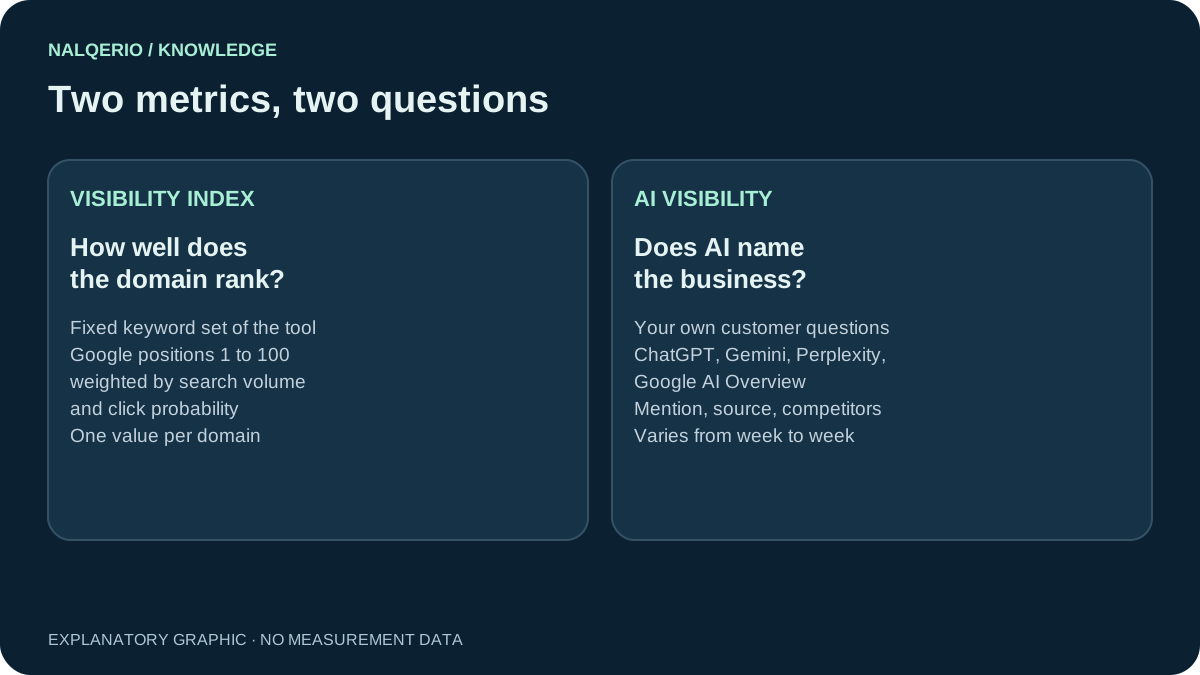
A visibility index summarises how well a domain ranks on Google for a fixed keyword set, weighted by search volume and click probability. It shows trends and comparisons, but not traffic. Scores from different tools are not comparable. Whether ChatGPT, Gemini, Perplexity or Google AI Overview name your business is not measured by the index. For that you need a second metric based on your own customer questions.
What is a visibility index?
A visibility index is a metric that describes how present a domain is in Google’s search results. SISTRIX made it popular and has calculated its Visibility Index since 2008. Today many SEO tools offer their own versions, such as XOVI, Semrush or SE Ranking.
The idea is simple: instead of looking at hundreds of individual rankings, you get one number per domain and week. If it rises, the website has become more visible overall. If it drops sharply, it is worth looking for the cause, such as a Google update or a technical error.
How a visibility index is calculated
Each tool has its own formula, but the principle is similar:
- Fixed keyword set: the tool regularly checks a large, stable list of search terms. For Germany, SISTRIX has used one million keywords since 2020.
- Record rankings: for each term it records which domain holds which position in the top 100 results.
- Weight them: a position for a frequently searched term counts more than one for a rare term. Click probability is weighted too: position 1 brings far more than position 9.
- Add them up: all the weighted values for a domain make up the index.
Two things follow. First, terms that are not in the keyword set do not count. For a local trade business with very specific searches, the index can be tiny even though the website brings in good enquiries. Second, a score from tool A cannot be compared with one from tool B, because keyword sets and weightings differ.

What is a good visibility index?
There is no fixed threshold for a “good” score. The index depends heavily on industry, size and topic breadth. An online shop with thousands of products reaches completely different scores than a tax adviser in one city. Three comparisons make sense:
| Comparison | Question | Value |
|---|---|---|
| With yourself over time | Is my domain becoming more or less visible? | high, as long as you use the same tool |
| With direct competitors | How do I compare with similar providers? | medium, if the keyword set covers your topics |
| With other industries | Is 0.5 a lot or a little? | low, because topics and search volumes differ too much |
Focus on the trend more than the absolute number. A stable or rising curve matters more than whether the number has two or three digits.
How to check visibility for free
Many providers show a domain’s visibility index for free in a limited form, during a trial or as a preview. That is usually enough for a first impression. Free and often more meaningful for your own website is Google Search Console:
- Impressions show how often your pages appear in search, for all search terms, not just a keyword set.
- Average position and clicks show how well you rank and whether that turns into visits.
- Queries reveal which topics Google shows you for at all.
The difference: Search Console only sees your own website. For comparing yourself with competitors, a visibility index from a tool remains useful.
What a visibility index cannot show about AI answers
A visibility index measures classic rankings. Two developments have made it less complete since 2025:
- AI Overviews above the results. According to SISTRIX, just over one search in five in Germany shows an AI Overview. The click-through rate for position 1 then drops from about 27 to 11 percent. Your ranking, and therefore your index, can stay the same while visits fall. More in our guide to Google AI Overview.
- Recommendations outside Google. Whether ChatGPT, Gemini or Perplexity name your business does not show up in any index that counts Google rankings.
The second metric: AI visibility
AI visibility answers a different question: does an AI name your business when a customer asks for a provider? There is no fixed keyword catalogue for this. The basis is your own customer questions, such as “Which tax adviser in Leeds knows about solar panels?”.
The biggest difference from a visibility index is volatility. In our web agency study, the same AI named only 35 percent of the agencies again one week later for the same question. 86 percent of the agencies were recommended by only one of the three AIs tested. A single query is therefore about as meaningful as a single day of a visibility index: hardly at all.
| Feature | Visibility index | AI visibility |
|---|---|---|
| Basis | the tool’s fixed keyword set | your customer questions |
| Measures | Google positions | mentions, sources and competitors in answers |
| Systems | ChatGPT, Gemini, Perplexity, Google AI Overview | |
| Volatility | low, weekly trend | high, only meaningful over repeated runs |
How to set up such a measurement is shown in our guide to measuring AI visibility. You can calculate your share compared with competitors using the calculator in our share of voice guide.
How to combine both metrics
Three numbers, compared once a month, give you the full picture:
- Visibility index or Search Console impressions: how present am I in classic search?
- Clicks and enquiries: what actually arrives?
- AI visibility: for how many of my customer questions do AI systems name me, and whom do they name instead?
If all three rise together, you are heading the right way. If the index rises but enquiries fall, look at AI Overviews. If AI visibility is low despite good rankings, external sources such as reviews, directories or articles are often missing. A monthly report template is in our GEO reporting guide.
The free AI check tests your AI visibility in ChatGPT in about a minute. To measure it regularly across four AI systems, you can try Nalqerio free for 14 days.
Frequently asked questions
What is a visibility index?
A metric that describes how well a domain ranks on Google for a fixed keyword set. Positions are weighted by search volume and click probability. SISTRIX made it popular.
What is a good visibility index score?
There is no universal value. What matters is the trend over time and the comparison with direct competitors in the same tool. Scores from other industries say little.
Can I check my visibility index for free?
Many tools show it in a limited form for free or during a trial. For your own website, the free Google Search Console often gives more precise data with impressions, positions and clicks.
Are visibility indexes from different tools comparable?
No. Each tool uses its own keyword set and weighting. Only compare scores from the same tool.
Is there a visibility index for AI?
There is no generally accepted AI visibility index. A practical approach is your own measurement: for how many of your customer questions do ChatGPT, Gemini, Perplexity and Google AI Overview name your business, repeated over several weeks.
Why is my traffic falling while my visibility index is stable?
A common cause is AI Overviews: your ranking stays, but fewer people click because the answer is already at the top. Check in Search Console whether impressions are stable and only clicks are falling.
Sources and further reading
- SISTRIX: AI Overviews in Germany – how much click-through rates are really dropping
- SISTRIX: Visibility Index
- Google Search Console
- Nalqerio study: Which web agencies do ChatGPT, Gemini and Perplexity recommend?
Methods, product scope and sources reflect the publication date shown. Examples are not measurements of your website. Linked product pages provide current plan and provider details.
