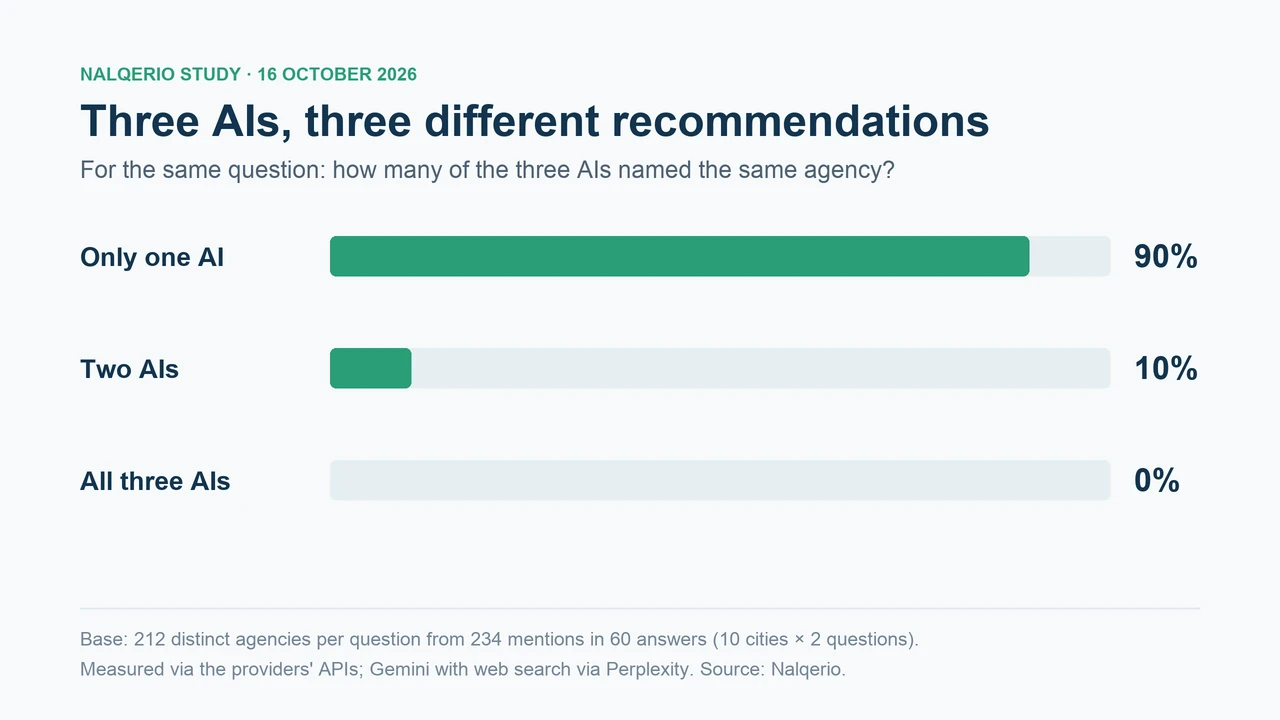
Every one of the 60 answers named specific agencies, almost four on average. Yet the three AI assistants barely agreed: 90% of the agencies appeared in only one of the three answers to the same question, and not a single one in all three. Even a slightly different wording led to almost entirely different recommendations. The study is a snapshot from 16 October 2026 and shows why a single sample says little about your own visibility.
The key findings at a glance
- Every answer names specific agencies: between one and eight, 3.9 on average. There was no generic advice without names.
- The three AIs barely agree: 90% of the agencies named appeared in only one of the three answers to the same question, about 10% in two. In none of the 20 questions did all three name the same agency.
- Wording matters: asking the same AI in the same city in slightly different words, the recommendations overlapped by only around 4% on average.
- Many names, little repetition: each city produced 15 to 23 different agencies from just six answers. Only 15% of them were named more than once.
- Different sources: Perplexity and Gemini cited sources in every answer, ChatGPT usually one. Directories, rankings and agency lists mattered mainly for ChatGPT and Perplexity.
How we measured
In Germany's ten largest cities – Berlin, Hamburg, Munich, Cologne, Frankfurt am Main, Düsseldorf, Stuttgart, Leipzig, Dortmund and Essen – we asked two questions each in German, the way businesses phrase them:
- “Which web agency in [city] can you recommend?”
- “I am looking for an agency in [city] that builds a new company website and makes it visible on Google. Which providers should I consider?”
Each of the 20 questions went once to ChatGPT (OpenAI API with web search), to Perplexity (Sonar API) and to Gemini. For Gemini, the Gemini model writes the answer while Perplexity provides the web search in our measurement – not Google Search. The reason: the Gemini API terms prohibit storing or analysing results of its built-in Google Search grounding (Gemini API Additional Terms of Service). A study has to store and analyse answers, so we combine the Gemini model with Perplexity's web search. The Gemini results therefore show which agencies the Gemini model recommends from these search results – not what the Gemini app would answer with Google Search.
All 60 answers were collected on 16 October 2026 and analysed with Nalqerio: agencies named, sources cited and overlaps. We merged the same agency written slightly differently, for example with or without its legal form. Cited sources were classified automatically by domain and address: website of a named agency; directory, ranking or list; or other page.
For context: we measured the API answers. Consumer apps may answer differently, and AI answers change from day to day. How we collect and analyse answers in general is explained in the Nalqerio methodology.
For a manual comparison of your own, the AI search engine guide explains which interface and context details also need recording.
Three AIs, three different recommendations
For the same question, ChatGPT, Gemini and Perplexity almost always named different agencies. Together, the 60 answers named 234 agencies. Merging the same agency within each question leaves 212 – 90% of them appeared in only one of the three answers, 10% in two. No question produced an agency that all three recommended. Across the ten cities, this added up to about 200 different agencies.
| Comparison | Questions with at least one shared agency |
|---|---|
| ChatGPT and Gemini | 4 of 20 |
| ChatGPT and Perplexity | 5 of 20 |
| Gemini and Perplexity | 11 of 20 |
| All three | 0 of 20 |
Gemini and Perplexity were the most similar – plausible, since both use the same web search in our measurement. What stands out is how low the agreement still was: they shared any agency in only 11 of 20 questions. Not just the search source but the language model itself decides who gets recommended. For agencies this means: being named by one AI does not make you visible in the others.
A small change, a very different answer
A second effect stood out: even the same AI recommended almost entirely different agencies when the question was worded slightly differently. Whether we asked for “a web agency” or “an agency for a website and Google visibility” made a big difference. On average, the two lists of the same AI in the same city overlapped by only around 4%: 3% for ChatGPT and 5% each for Gemini and Perplexity. In 22 of 30 cases they had no agency in common.
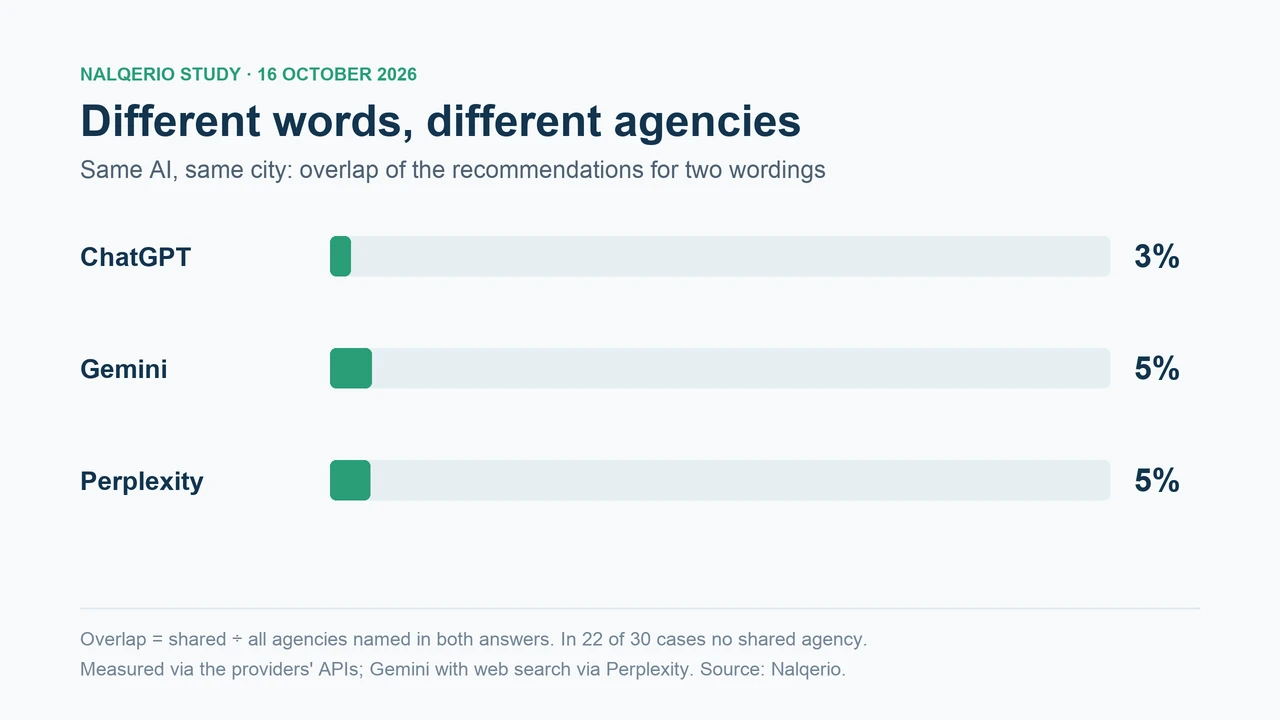
A single sample – “I asked ChatGPT and we were named” – therefore says little. It becomes meaningful when you measure several real customer questions across several AI assistants repeatedly. The guide to measuring AI visibility shows how.
Where the recommendations come from
| AI assistant | Sources per answer | Answers citing a directory, ranking or list |
|---|---|---|
| Perplexity | 4.0 | 10 of 20 |
| Gemini (web search via Perplexity) | 3.5 | 1 of 20 |
| ChatGPT | 1.1 | 7 of 20 |
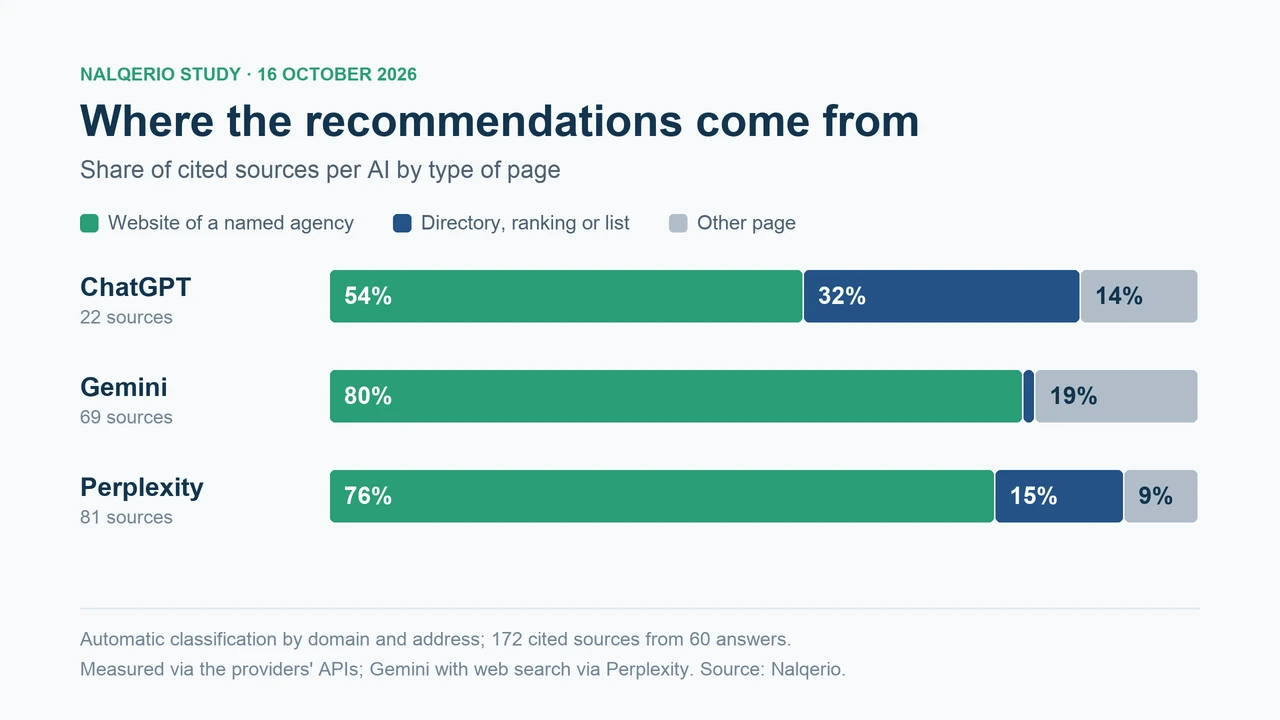
Gemini almost always pointed directly to the websites of the agencies it named: 80% of its sources were agency websites. For ChatGPT, almost one source in three came from a directory, ranking or list; for Perplexity about one in seven. The most cited source overall was the German directory agenturtipp.de (11 times); among directories, sortlist.de followed (4 times). ChatGPT backed 18 of 20 answers with at least one source, usually exactly one.
This gives agencies two levers: their own website, clearly answering service and city, and complete profiles in the directories the AIs rely on. For local providers, the guide to local AI visibility goes deeper.
What agencies can do now
- Align your website clearly with city and service. One page per core service and location, with references, contacts and verifiable details.
- Be present in relevant directories. Check which agency lists are cited for your customer questions and keep your profile there complete and current.
- Measure regularly instead of asking once. Define three to five real customer questions and check them across several AI assistants at fixed intervals.
Frequently asked questions
How many answers were analysed?
60 answers: ten cities, two questions each, asked to ChatGPT, Gemini and Perplexity. All answers are from 16 October 2026.
Why is there no ranking of agencies?
Individual agencies were named two or three times at most. A ranking based on that would be random and misleading. The pattern is what matters: how little the AIs agree.
Do the apps answer like the APIs?
Not necessarily. We measured the providers' APIs. Consumer apps may use other models, settings or search sources. For Gemini, Perplexity provided the web search in our measurement.
Why does Gemini use Perplexity's web search in this study?
The Gemini API terms prohibit storing or analysing results of its built-in Google Search grounding. A study has to store and analyse answers, so we combine the Gemini model with Perplexity's web search and disclose it. The Gemini app may name other agencies with Google Search.
Can I repeat the measurement for my own agency?
Yes. With Nalqerio you define the questions your customers ask and see per AI assistant whether you are named, which sources are cited and which competitors appear instead.
Sources and further reading
- Nalqerio: Methodology
- OpenAI: Web search in the API
- Perplexity: Sonar API documentation
- Google: Gemini API documentation
- Google: Gemini API Additional Terms of Service
Methods, product scope and sources reflect the publication date shown. Examples are not measurements of your website. Linked product pages provide current plan and provider details.
