Agentic commerce means AI agents search for, compare and buy products on behalf of people. Open protocols are emerging for this: ACP from OpenAI and Stripe, UCP from Google and partners, and AP2 for payments. OpenAI ended its in-chat instant checkout in March 2026, while product search in ChatGPT continues. What counts for retailers now is clean product data, clear terms and visibility in AI answers.
Agentic commerce: the meaning in one sentence
Agentic commerce describes purchases in which an AI agent acts on behalf of a person: it understands the request, looks for suitable products, compares prices, delivery times and return terms and prepares the order. The person approves it at the end.
The difference from familiar online shopping is who does the clicking. Until now customers visited shops and compared them. In agentic commerce a program does that, and the customer often only sees the result. For retailers this means the first “visitor” you have to convince is a machine that reads data.
How a purchase with an AI agent works
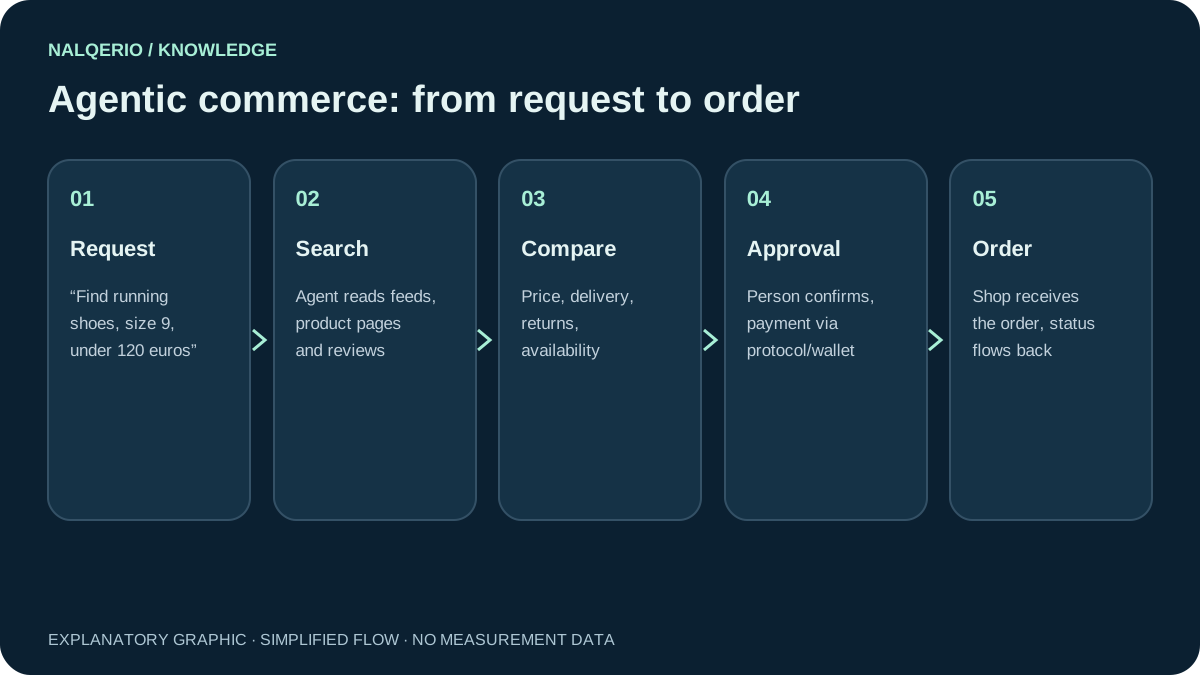
Steps two and three are decisive. An agent can only compare products it finds and understands. To do that it reads product feeds, structured data on product pages, reviews and terms. If the price is missing, availability is unclear or shipping costs only appear in an image, the product drops out of the comparison.
At approval, the customer pays either directly in the assistant, through a stored wallet or in the retailer’s shop. Which option applies depends on the assistant and the protocol.

ACP, UCP and AP2: the key standards
For agents to talk to many shops, they need shared rules. Several open protocols emerged for this in 2025 and 2026:
| Protocol | From | Purpose |
|---|---|---|
| ACP – Agentic Commerce Protocol | OpenAI and Stripe, published openly | product data and checkout between AI assistant and retailer |
| UCP – Universal Commerce Protocol | Google with Shopify, Etsy, Wayfair, Target, Walmart and others | catalogue search, cart, checkout, customer account and order status |
| AP2 – Agent Payments Protocol | Google and partners | payments by agents with verifiable customer approval |
According to the project site ucp.dev, payment providers such as Visa, Mastercard, American Express, PayPal, Stripe and Adyen also support the standard. The protocols are not mutually exclusive: large retailers work with several at once, and payment providers handle both routes.
For most small and mid-sized shops: you do not have to implement a protocol yourself. Shop systems, marketplaces and payment providers do that. Ask your provider which standards it supports and when.
What happened to ChatGPT Instant Checkout
In September 2025 OpenAI launched “Instant Checkout” in the US: users could buy certain products directly in the chat without visiting the shop. It was based on the Agentic Commerce Protocol. In March 2026 OpenAI ended instant checkout again. According to reports, usage stayed low and retailers wanted to keep their own checkouts.
Since then ChatGPT has focused on product search: it recommends products and sends people to the retailer’s shop to buy. ACP itself continues. For retailers, the lesson from this chapter is clear:
How products appear in ChatGPT today and which data counts is explained in our guide to ChatGPT shopping for retailers.
What online shops should prepare now
Whether you use Shopify, Shopware, WooCommerce or your own system, preparing for agents starts with data. These six points help most:
- Complete product data. Title, description, brand, GTIN, variants, size, colour, material. What an agent cannot find, it cannot compare.
- Current price, availability and shipping. Differences between feed and page cost trust and lead to rejections.
- Structured data on every product page. Product and Offer with price, currency, availability, shipping and returns. The guide is at product schema.
- Maintain Merchant Center. Google also uses Merchant Center data for its AI features.
- State terms clearly. Returns, warranty, delivery times and payment methods as text, not hidden in PDFs.
- Collect reviews. Agents weigh other customers’ experiences, just like people do.
How product pages should be built for search and AI overall is covered in our guide to e-commerce SEO and GEO.
Legal basics: what does not change
Even when an agent prepares the purchase, the contract is still between customer and retailer. For shops in the EU this means price information, information duties, the right of withdrawal and a clear order button still have to be correct. Where the purchase is completed inside the assistant, the provider’s terms set out who takes on which obligations.
Before you join an agent programme, clarify three questions: Who shows the customer the mandatory information? Who is the contracting party? Who handles withdrawals and returns? If in doubt, ask a legal adviser.
Get visible before the agent searches
An agent first asks an AI search which shops and products are worth considering. If you are missing from those answers, you are never compared. So preparation also means asking: do ChatGPT, Gemini, Perplexity and Google AI Overview name your shop or brand for typical buying questions?
Try it: buying question
Ask an assistant: “Which online shop sells [your product] with fast delivery to [your country]?” Note who is named.
Try it: comparison
“Compare [your product] with [alternative] by price and return terms.” Are your details correct in the answer?
Try it: terms
“How much is shipping at [your shop] and how long can I return items?” Wrong details point to unclear sources.
Try it: reviews
“What do customers say about [your shop]?” The answer shows which review sources the AI knows.
The free AI check shows in about a minute whether ChatGPT names you for two typical customer questions. For regular measurement across four AI systems, you can try Nalqerio free for 14 days.
Frequently asked questions
What is agentic commerce?
Agentic commerce describes purchases in which an AI agent searches for products, compares them and prepares the order on behalf of a person. The person approves the purchase at the end.
What is the Agentic Commerce Protocol (ACP)?
An open protocol from OpenAI and Stripe that defines how AI assistants and retailers exchange product data and orders. It was the basis for ChatGPT Instant Checkout and continues to exist.
What is the difference between ACP and UCP?
ACP comes from OpenAI and Stripe, UCP from Google with partners such as Shopify, Etsy and Walmart. UCP also covers customer accounts and order status and uses AP2 for payments. Retailers can use both in parallel.
Does ChatGPT Instant Checkout still exist?
No. OpenAI ended in-chat instant checkout in March 2026. ChatGPT still recommends products and sends people to the retailer’s shop to buy.
Does a small shop need its own integration?
Usually not. Shop systems, marketplaces and payment providers implement the protocols. Your job is complete product data, clear terms and well-maintained feeds.
Is agentic commerce available in Europe yet?
Many features launch in the US first. Product recommendations in AI assistants already exist in Europe, though, so preparing good product data pays off now.
Sources and further reading
- Universal Commerce Protocol (UCP): project site
- Agentic Commerce Protocol (ACP): project site
- Checkout.com: OpenAI’s agentic commerce shift – what it means for merchants
- Google Search Central: AI features and your website
- Nalqerio: ChatGPT shopping for retailers
Methods, product scope and sources reflect the publication date shown. Examples are not measurements of your website. Linked product pages provide current plan and provider details.
