Ads in ChatGPT are labelled, paid placements below an answer. They reach only Free and Go users and, according to OpenAI, do not influence the answer. To be recommended inside the answer, you need clear information on your own website and in trusted sources. The two can complement each other.
What are ChatGPT ads?
OpenAI started testing ads in ChatGPT on 9 February 2026, first in the United States, and has been rolling them out to more countries since. An ad appears below an answer, is labelled as advertising and is kept separate from the answer text. ChatGPT shows at most one ad unit per answer, which may contain one or several images.
A separate ads system decides which ad appears. It considers, among other things, the topic of the current chat, the landing page, the ad title and copy, the advertiser’s targeting and its bid. This is how OpenAI describes it in its help article on ads in ChatGPT.
Who sees ads in ChatGPT?
Not every ChatGPT user sees advertising. According to OpenAI:
- Ads appear only on the Free and Go plans. Plus, Pro, Business, Enterprise and Edu stay ad-free.
- Accounts identified as belonging to minors see no ads.
- Temporary chats show no ads.
- No ads appear next to sensitive topics such as health, mental health or politics. Political advertising is currently not allowed.
- Personalised ads are initially not available in the European Economic Area and Switzerland. There, ads follow the content of the current chat.
This means that decision-makers who use a paid plan cannot be reached with ads. The answer text has no such limit: every user sees the same kind of recommendation there.
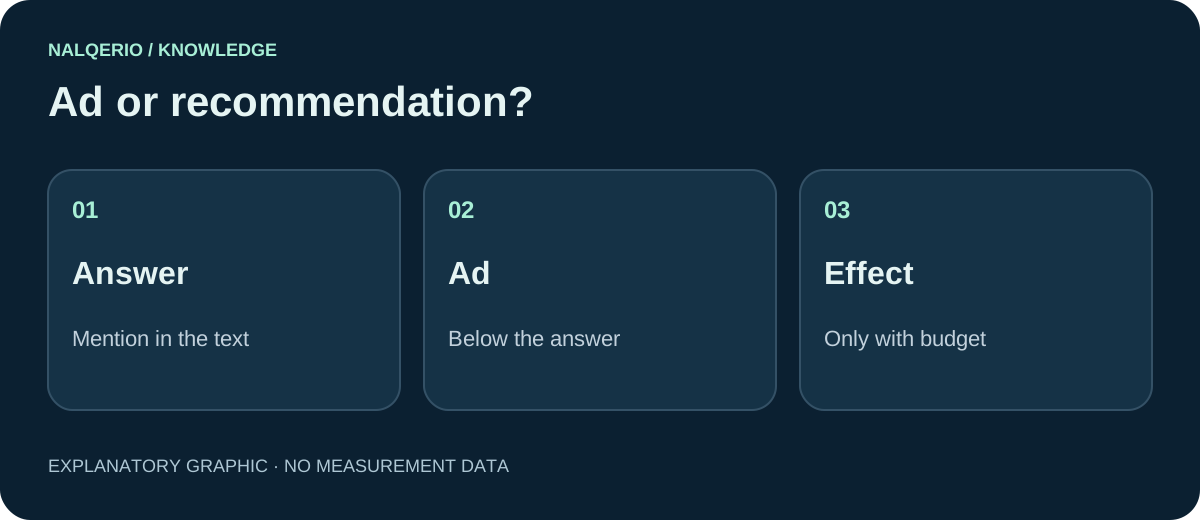
Ad or recommendation: the key difference
OpenAI stresses that ads do not influence answers. Advertisers can neither shape answers nor change their order, and an ad is not an endorsement by OpenAI. For your business this means: budget buys the space below the answer. You only get into the answer itself if ChatGPT considers your business a good fit for the question.
| Aspect | Ad in ChatGPT | Mention in the answer |
|---|---|---|
| Placement | below the answer, labelled as an ad | inside the answer text |
| Who sees it? | Free and Go users only, not next to sensitive topics | in principle all users |
| Cost | ad budget per campaign | no click costs, but work on website and sources |
| Controllable? | via bid, targeting and ad copy | not directly, only through clear, verifiable information |
| Effect | ends with the budget | lasts as long as the sources are accurate |
How ChatGPT selects businesses to recommend and what you can improve on your website is covered in the ChatGPT SEO guide. Why a business is not named at all is explained in business missing from AI answers.
How businesses book ChatGPT ads
Ads are set up in the Ads Manager at ads.openai.com. According to the availability overview, self-service is available in many countries, including the United States, the United Kingdom, Germany, Austria and Switzerland (October 2026). The legal entity that advertises and is billed must be based in a listed country. Larger advertisers can also contact OpenAI’s ads team or agency partners.
Keep three points in mind when setting up:
- Account country, currency and time zone cannot be changed later.
- Regulated categories such as health and finance face strict eligibility rules. An approved ad may still not run in certain countries.
- Reports contain aggregated figures such as views and clicks. Advertisers never receive users’ conversations.
Prices, minimum budgets and billing models are changing in this early phase. Check the current details in the Ads Manager and in OpenAI’s advertising terms.
Are ChatGPT ads worth it for small businesses?
It depends on your goal. Ads can make sense if you have a clear offer with a matching landing page and want to test quickly whether enquiries come in. They are less suited to being seen as a trusted provider over the long term, because the effect ends with the budget.
For a fair test, use a small fixed budget, a dedicated landing page and links with campaign parameters. Your analytics will then show how many visitors really come from ChatGPT. How to analyse visits from AI assistants is explained in measure AI traffic.
At the same time, look at the unpaid side: is your business named in the answers when customers ask for a provider in your town? If not, ads also lose impact, because users read other names in the answer right above them.
Your first step: check whether ChatGPT already names you
Before you plan a budget, know where you stand. The free AI check asks ChatGPT two typical customer questions about your type of business and your town, without your company name. In about a minute you see whether your business is named and who ChatGPT recommends instead.
If you want to track this regularly, including Gemini and Perplexity, you can try Nalqerio free for 14 days if you have not used the free trial before. No credit card, no automatic paid renewal. More on the pricing page.
Frequently asked questions
Can advertising make ChatGPT recommend my business?
No. According to OpenAI, ads do not influence answers. An ad appears labelled below the answer. Whether your business is named in the answer depends on the information ChatGPT finds about you.
Who sees ads in ChatGPT?
Only users on the Free and Go plans, no minors and no users of paid plans such as Plus, Pro or Business. No ads appear next to sensitive topics such as health or politics.
Can I book ChatGPT ads myself?
In many countries, yes. OpenAI’s availability overview lists the countries where the self-service Ads Manager is open, including the US, UK and Germany (October 2026). Health and finance are subject to stricter rules.
Sources and further reading
- OpenAI Help Center: Ads in ChatGPT
- OpenAI Help Center: Ads Manager Availability
- OpenAI: Advertising Terms
- Nalqerio: free AI check
Methods, product scope and sources reflect the publication date shown. Examples are not measurements of your website. Linked product pages provide current plan and provider details.
